US News
The Supreme Court Decides: IEEPA Tariffs Unlawful
By: Arpit Bhargava
On February 20, 2026, the U.S. Supreme Court held in V.O.S. Selections Inc. v. Trump that the International Emergency Economic Powers Act (IEEPA) does not authorize the President to impose tariffs because Congress never delegated that specific taxing power in the statute; consequently, all IEEPA tariffs were unlawful ab initio (from the start).
This ruling effectively dismantles the cornerstone of the administration’s aggressive trade agenda, invalidating the “reciprocal” tariffs and the targeted drug-trafficking duties on imports from China, Mexico, Canada, Brazil, and India.
Other trade regimes are not affected by this decision. This includes Section 232 national security tariffs (on steel, autos, aluminum, automobiles, semiconductors, solar panels, copper, and wood), Section 301 tariffs on Chinese goods related to unfair trade practices, and standard antidumping and countervailing duties (AD/CVD).
White House Reloaded: Section 122 Tariffs In, For Now
On February 20, 2026, President Trump invoked Section 122 of the Trade Act of 1974 to proclaim a new 10 percent global import surcharge to address “large and serious” U.S. balance-of-payments deficits. This new duty is scheduled to take effect at 12:01 a.m. EST on February 24, 2026. While classified as a “regular customs duty,” it operates as an additional surcharge collected over existing normal tariffs, though it does not stack with goods already subject to Section 232 national security measures.
Goods loaded on a vessel and already in transit to the United States before 12:01 a.m. EST on February 24, 2026, and imported before 12:01 a.m. EST on February 28, 2026, are also not covered by the section 122 surcharge. Key exclusions to the section 122 surcharge include critical minerals, agricultural products, pharmaceuticals, oil, and petrochemical products etc. A full list is available in Annex I and Annex II of the executive order.
By statute, this temporary import surcharge is limited to a maximum duration of 150 days and is currently scheduled to expire on July 24, 2026, unless extended by an act of Congress. Importers should be aware that the administration must meet specific statutory requirements regarding the balance-of-payments deficit to invoke Section 122, which may face future legal challenges. For a detailed analysis of this Executive Order and its specific regulatory impact, please refer to SBA’s US News page.
Status of Injunction on IEEPA Tariffs
There is currently no active nationwide injunction from the Supreme Court as to imposing IEEPA duties, as the Court vacated the preliminary injunction initially issued by the D.C. District Court for lack of jurisdiction and remanded the V.O.S. Selections case back to the Court of International Trade (CIT) to reconsider the proper scope of relief as to the found illegal IEEPA tariffs. However, on February 20, 2026, President Trump issued the Executive Order “Ending Certain Tariff Actions,” which formally rescinds the additional ad valorem duties previously imposed under IEEPA authorities. This order officially directs that the collection of these invalidated duties must cease as soon as practicable. Thus, for now the collection continues and retroactive refund of prior IEEPA duties not addressed.
U.S. businesses are still paying IEEPA tariffs even after the Supreme Court decision to strike down President Trump’s IEEPA tariffs, until CBP advises otherwise. It could take days or weeks for CBP to officially tell importers that the IEEPA tariffs are no longer in force to be paid.
Refunds of IEEPA Tariffs and Remedies going forward
The Supreme Court did not create a special refund mechanism. Importers will need to use existing Customs and court processes to seek refunds, and the options available depend on whether entries are liquidated or unliquidated. It could be months before the lower courts or US Customs and Border Protection (CBP) establish any refund process. The U.S. Court of International Trade (CIT) is expected to oversee the refund process, which will be administered electronically by CBP once the court and/or CBP issues specific implementation orders. At least for now, the U.S. Administration is signaling that there could be years of litigation on this issue but has certainly shown that U.S. Administration policy can change rapidly.
- Importers who have already filed protective lawsuits in the U.S. Court of International Trade (CIT) are expected to have a clear path forward through court-ordered reliquidation. The CIT is well-positioned to order relief in these pending 28 U.S.C. § 1581(i) cases, and CBP has previously indicated it will not oppose reliquidation if the Supreme Court holds the tariffs unlawful.
- Unliquidated entries (PSC route). For entries that have not yet liquidated, the primary duty relief tool is Post Summary Correction (PSC), which allows correction of duty calculations before liquidation. PSCs generally may be filed on entries within about 300 days of importation and at least 15 days before scheduled liquidation; once an entry liquidates, PSCs are no longer available.
- Liquidated entries (protest and litigation route). After liquidation, refund claims shift to protests. Importers generally have 180 days from liquidation or reliquidation to file a protest. If CBP denies a protest, importers may challenge that denial at the CIT within 180 days. Note also that as to import entries liquidated more than 180 days ago, such that cannot now protest their liquidation, as the statutory time to do so has expired, can still file a 1581(i) court case (per the first bullet point above) that covers up to two years back from the time of the court appeal as a protective measure at this point, if wish
Importers should note that when products are also subject to anti-dumping (AD) and countervailing duties (CVD), the treatment of these refunds in dumping margin calculations requires a more complex AD/CVD law specific analysis to ensure proper treatment in administrative reviews, having nothing to do with IEEPA.
Note that most importers did not file court appeals yet as to the IEEPA tariffs. Much of Corporate America is pushing for a general refund of all IEEPA tariffs for all, which could be done if the U.S. Administration were willing to do so (so far not). With (a) impending November 2026 Congressional mid-term elections coming, (b) the huge unpopularity of the IEEPA tariffs among American voters, (c) Trump’s increasing unpopularity in the U.S. with resistance to Trump growing, (d) Trump’s Republican Members of Congress worried as to their own re-election in November 2026, and (e) the $140+ billion of collected IEEPA tariffs so far (with implications for the U.S. budget deficit), interesting dynamics are set into play with unclear/uncertain resolution at this point as to how it plays out.
Further practical next steps for importers:
- Inventory all entries where IEEPA tariffs were paid. Confirm which entries are still unliquidated and which have liquidated, including the relevant dates, to assess best steps going forward as to above.
Entry Status | Administrative Action Required | Statutory Deadline | Expected Disbursement Mechanism |
Unliquidated | File Post-Summary Correction (PSC) via ACE | Within 300 days, up to 15 days prior to scheduled liquidation | Refunded at final liquidation via ACH |
Liquidated | File Formal Protest (Form CF-19) under 19 U.S.C. § 1514 | Strictly 180 days from the date of liquidation. | Electronic ACH transfer (subject to CBP review) |
Litigated | Adherent to CIT reliquidation implementation orders | Subject to CIT scheduling | Court-ordered reliquidation via CBP ACH system |
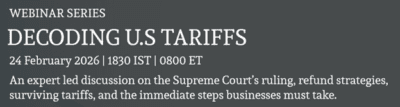
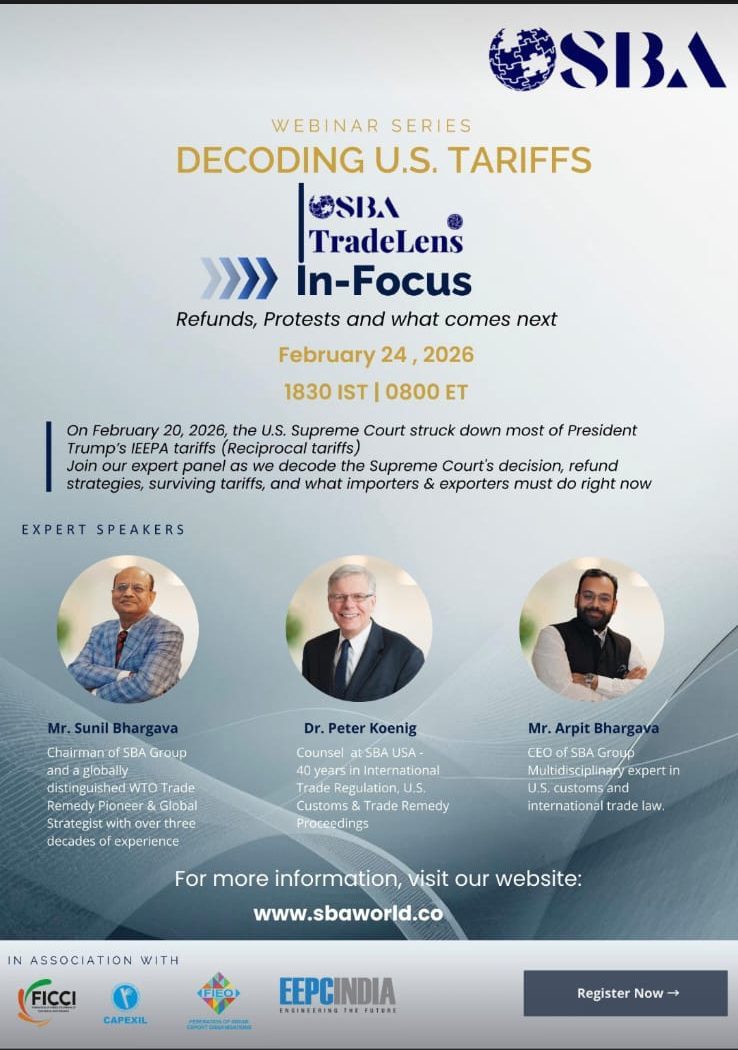
Join our panel of experts in the webinar series “Decoding US Tariffs” through February 24, 2026, to March 19, 2026, to get updates. Click here to register.
The professionals at SBA have deep experience advising clients on the range of issues associated with the IEEPA tariffs, the US Customs and Border Protection’s operational and administrative process for tracking and seeking refunds, and the disposition of those tariffs on appeal.
Our team includes Arpit Bhargava, Founding Partner and CEO, who is a Chartered Accountant and master’s in business law with rich experience in international trade laws and practice, and Dr. Peter Koenig, who brings almost 40 years of experience in international trade regulation, including antidumping and countervailing duty proceedings, U.S. Customs, and trade policy. For more information, please contact any of the authors or another professional at SBA that you regularly work with.
White House Reloaded: Section 122 Tariffs In, For Now
By: Dr. Peter Koenig
The legal and economic landscape of United States trade policy underwent a fundamental realignment on February 20, 2026, the same day the Supreme Court invalidated the executive branch’s use of the International Emergency Economic Powers Act (IEEPA) for broad-based tariffs. In an immediate response, President Trump proclaimed a new 10 percent global import surcharge under Section 122 of the Trade Act of 1974. This strategic shift serves to address “fundamental international payments problems” while bypassing the judicial constraint that requires an express delegation from Congress for tariff imposition. Effective February 24, 2026, this surcharge applies on an across-the-board basis for 150 days—currently scheduled through July 24, 2026—unless specifically exempted through the technical framework detailed in Annex I and Annex II.
Section 122 authorizes the President to impose temporary, “non-discriminatory” surcharges of up to 15 percent ad valorem to restore international economic equilibrium. Media sources have noted that Mr. Trump may increase this duty to 15%, which is maximum permissible for cush action under the Trade Act. The initial action imposes a 10 percent rate that applies in addition to existing tariffs, though it excludes USMCA-qualifying goods and articles already subject to Section 232 restrictions—where Section 232 applies only to a portion of a product, the Section 122 surcharge applies to the remainder.
Goods loaded on a vessel and already in transit to the United States before 12:01 a.m. EST on February 24, 2026, and imported before 12:01 a.m. EST on February 28, 2026, are also not covered by the section 122 surcharge. Key exclusions to the section 122 surcharge include critical minerals, agricultural products, pharmaceuticals, oil, and petrochemical products etc. A full list is available in the executive order.
By statute, this temporary import surcharge is strictly limited to a maximum duration of 150 days and is currently scheduled to expire on July 24, 2026, unless extended by an act of Congress.
Notably, the proclamation has already drawn legal scrutiny; critics suggest the administration may have violated Section 122 by potentially failing to satisfy specific statutory triggers, which include large and serious balance-of-payments deficits, an imminent and significant depreciation of the dollar in foreign exchange markets, or the need to cooperate with other countries in correcting a payments disequilibrium. In potential court challenges, the administration will be required to demonstrate that these rigorous financial requirements were met to justify the ongoing use of the surcharge.

Join our panel of experts in the webinar series “Decoding US Tariffs” through February 24, 2026, to March 19, 2026, to get updates. Click here to register.
The professionals at SBA have deep experience advising clients on the range of issues associated with the US tariffs and the US Customs and Border Protection’s operational and administrative procedures. Our team includes Arpit Bhargava, Founding Partner and CEO, who is a Chartered Accountant and Master in Business Law with rich experience in international trade laws and practice, and Dr. Peter Koenig, who brings almost 40 years of experience in international trade regulation, including antidumping and countervailing duty proceedings, U.S. Customs, and trade policy. For more information, please contact any of the authors or another professional at SBA that you work with.
List of HS codes excluded from Section 122 Surcharge
as per Annex I and Annex II
| USHTS Code | Description | Country of Origin | Chapter 9903 Heading |
| 0201.10.05 | Bovine carcasses and half-carcasses, fresh or chilled: Described in general note 15 of the tariff schedule and entered pursuant to its provisions. | All Sources | 9903.03.03 |
| 0201.10.10 | Bovine carcasses and halves, fresh or chilled, described in additional U.S. note 3 to chapter 2 of the HTSUS. | All Sources | 9903.03.03 |
| 0201.20.02 | High-quality beef cuts, bone in, processed, fresh or chilled, described in general note 15 of the HTSUS. | All Sources | 9903.03.03 |
| 0201.30.80 | Bovine meat cuts, boneless, fresh or chilled, not described in general note 15 or additional U.S. note 3. | All Sources | 9903.03.03 |
| 0206.21.00 | Edible offal of bovine animals, frozen: Tongues. | All Sources | 9903.03.03 |
| 0702.00.20 | Tomatoes, fresh or chilled, if entered March 1 to July 14, or Sept 1 to Nov 14 in any year. | All Sources | 9903.03.03 |
| 0709.99.10 | Chayote (Sechium edule), fresh or chilled. | All Sources | 9903.03.03 |
| 0801.11.00 | Coconuts, desiccated. | All Sources | 9903.03.03 |
| 0804.40.00 | Avocados, fresh or dried. | All Sources | 9903.03.03 |
| 0805.90.01 | Etrogs. | All Sources | 9903.03.04 |
| 0811.90.80 | Tropical fruit, nesoi, frozen, whether or not previously steamed or boiled. | All Sources | 9903.03.04 |
| 0901.11.00 | Coffee, whether or not roasted or decaffeinated: Coffee, not roasted: Not decaffeinated. | All Sources | 9903.03.03 |
| 0902.10.10 | Green tea (not fermented) in immediate packings of a content not exceeding 3 kg: Flavored. | All Sources | 9903.03.03 |
| 0904.21.20 | Fruits of the genus Capsicum or of the genus Pimenta, dried, neither crushed nor ground: Paprika. | All Sources | 9903.03.03 |
| 1404.90.90 | Date palm branches, Myrtus branches or other vegetable material, for religious purposes only. | All Sources | 9903.03.04 |
| 1602.50.08 | Other prepared or preserved meat, meat offal or blood: Of bovine animals: In airtight containers: Valued not over $1.56/kg. | All Sources | 9903.03.03 |
| 1905.90.10 | Bread, pastry, cakes, etc., for religious purposes only. | All Sources | 9903.03.04 |
| 1905.90.90 | Bakers’ wares, communion wafers, sealing wafers, for religious purposes only. | All Sources | 9903.03.04 |
| 2008.99.21 | Acai (otherwise prepared or preserved). | All Sources | 9903.03.04 |
| 2009.31.60 | Citrus juice of any single citrus fruit (non-orange/grape/lime), Brix <= 20, concentrated. | All Sources | 9903.03.04 |
| 2009.89.70 | Coconut water or juice of acai. | All Sources | 9903.03.04 |
| 2009.90.40 | Coconut water juice blends, not from concentrate, packaged for retail sale. | All Sources | 9903.03.04 |
| 2106.90.99 | Acai preparations for the manufacture of beverages. | All Sources | 9903.03.04 |
| 2825.50.30 | Copper oxides and hydroxides: Other. | All Sources | 9903.03.03 |
| 2922.50.50 | Amino-alcohol-phenols, amino-acid-phenols and other amino-compounds with oxygen function: Other. | All Sources | 9903.03.03 |
| 2934.99.01 | Nucleic acids and their salts: Other: Mycophenolate mofetil. | All Sources | 9903.03.03 |
| 2935.90.20 | Sulfonamides: Other: Other: Drugs. | All Sources | 9903.03.03 |
| 3301.29.51 | Essential oils other than those of citrus fruit, nesoi, for religious purposes only. | All Sources | 9903.03.04 |
| 3901.90.90 | Polymers of ethylene, in primary forms: Other: Other, nesoi. | All Sources | 9903.03.03 |
| 3917.21.00 | Tubes, pipes and hoses, and fittings therefore: Rigid: Of polymers of ethylene (limited to “Aircraft” scope). | All Sources | 9903.03.03 |
| 4001.22.00 | Natural rubber in other forms: Technically specified natural rubber (TSNR). | All Sources | 9903.03.03 |
| 7106.91.10 | Silver, unwrought or in semi manufactured forms: Other: Unwrought: Bullion and dore. | All Sources | 9903.03.03 |
| 8542.39.00 | Electronic integrated circuits: Other. | All Sources | 9903.03.03 |
| 9903.01.31 | Informational materials (publications, films, posters, recordings, news wire feeds, etc.). | All Sources | 9903.03.11 |
| Any | Originating goods qualifying for USMCA preferential treatment under General Note 11. | Canada | 9903.03.07 |
| Any | Originating goods qualifying for USMCA preferential treatment under General Note 11. | Mexico | 9903.03.08 |
| Any | Articles subject to Section 232 national security import restrictions (steel, aluminum, etc.). | All Sources | 9903.03.06 |
| Any | Specified textile and apparel articles entered duty-free under relevant FTAs (e.g., CAFTA-DR). | Specified FTA Partners | 9903.03.09 |
IEEPA Fentanyl Tariff Rollback under the China Truce: Summary of EO
The executive order titled “Modifying Duties Addressing the Synthetic Opioid Supply Chain in the People’s Republic of China”, dated November 4, 2025, lowers the additional ad valorem duty on specified Chinese goods from 20% to 10% as of November 10 2025, in light of the People’s Republic of China’s commitment to curb the export of precursor chemicals used in illicit synthetic opioids such as Fentanyl. The measure builds on earlier executive orders which had declared a national emergency over the influx of synthetic opioids and imposed escalating tariffs, and it retains the option for further adjustment should China fail to implement its commitments.
Summary Table
Element | Pre-truce level | Post-truce level | Notes |
Fentanyl-related tariff on Chinese goods | 20 % | 10 % | Reduction tied to China’s precursor- chemical controls. |
Reciprocal tariff on Chinese goods | Higher (in range of 34 % or more) | 10 % (for one year) | U.S. extended tariff pause; combined duty burden remains high. |
Implementation date | – | Effective 10 Nov 2025 | Executive orders scheduled to take effect then. |
Link to Executive Order
| – | – | MODIFYING DUTIES ADDRESSING THE SYNTHETIC OPIOID SUPPLY CHAIN IN THE PEOPLE’S REPUBLIC OF CHINA |
Current duty structure* | – | – | China now has the following duty structure: (BCD: As per HTS Code, Section 301: 25%, IEEPA Fentanyl: 10%, IEEPA Reciprocal: 10%) |
* For Other Products this is Generic & for exact HTS Code check U.S. Customs and Border Protection site.
For Any Queries Kindly Connect With Us on: Arpit Bhargava / Radhika Sharma / Dr. Peter Koenig
Applications Filed by LDGE Fair Trade Coalition Seeking the Imposition of Antidumping and Countervailing Duties on Large Diameter Graphite Electrodes from India and China
1. Background and Overview
On February 24, 2026, applications seeking the imposition of antidumping and countervailing duties on imports of large diameter graphite electrodes from China and India were filed before the U.S. Department of Commerce and the U.S. International Trade Commission. The applications were submitted by the LDGE Fair Trade Coalition, which represents the entirety of U.S. domestic production. The U.S. authorities are currently required to examine the applications to determine whether the statutory requirements for initiation are satisfied.
2. Period of Investigation
- Dumping and Subsidy Period of Investigation Department of Commerce 1st January, 2025 to 31st December, 2025.
- Injury Period U S International Trade Commission 1st January, 2023 to 31st December, 2025.
3. Petitioners and Domestic Industry Support
The petitions were filed by Tokai Carbon GE LLC and Resonac Graphite America Inc and are supported by GrafTech International Ltd a former U S producer. Petitioners account for 100 percent of U S large diameter graphite electrode production thereby satisfying the statutory standing requirements under U S trade law.
4. Indian Exporters & Producers
Identified in the Petition (add Chinese exporters)
- Graphite and Carbon Industries India Private Limited, Mumbai, Maharashtra, India.
- Graphite India Ltd., Kolkata, West Bengal, India.
- HEG Ltd., Noida, Uttar Pradesh, India.
5. Product Scope
Covered Merchandise
The investigations cover
- Large diameter graphite electrodes finished or unfinished
- Electrodes exceeding 425 millimeters 16 point 7 inches in nominal or actual diameter
- Electrodes with or without graphite pin joining systems
- Electrodes imported assembled or separately
For purposes of the investigation the country of origin is determined by the country of graphitization which is a critical factor for scope and circumvention analysis.
Indicative HTSUS classifications include 8545.11.0020, 3801.10.5090, and 3801.90.0050, though the written scope description is dispositive.
6. Trade Volumes
| Source/ Year | 2022 | 2023 | 2024 | Jan-Nov 2024 | Jan-Nov 2025 |
| India | 3,543 | 2,082 | 2,294 | 2,162 | 792 |
| China | 3,957 | 4,950 | 5,947 | 4,629 | 3,564 |
| Total Imports | 45,961 | 30,980 | 25,920 | 22,163 | 20,497 |
*all data is in metric tons
7. Key Allegations
I. Antidumping Allegations
Alleged dumping margins are as follows;
China
Alleged dumping margins exceeding 36.82 percent to over 146.41 percent including very high transaction specific margins due to constructed normal value methodologies.
India
Alleged dumping margins range approximately from 42.92 percent to over 74.02 percent depending on the producer exporter and product configuration and if accepted even in part may result in very high provisional cash deposit requirements at the preliminary determination stage.
II. Countervailing Duty Allegations
The petitions allege that producers in China and India benefit from actionable government subsidies including:
- Preferential financing and state backed lending
- Provision of inputs including raw materials and energy at less than adequate remuneration
Tax incentives and regional development programs - Export linked and performance-based incentive schemes
- Purchase of Coal at less than adequate remuneration (LTAR)
The petitions emphasize the capital intensive and energy intensive nature of graphite electrode production which magnifies the impact of subsidization.
8. Injury Allegations
The U S International Trade Commission is examining whether imports from China and India have increased significantly in absolute and relative volume have undercut suppressed and depressed U S prices and have reduced capacity utilization profitability and market share of the domestic industry while also creating a threat of material injury due to excess capacity and export orientation of foreign producers. Petitioners further assert that large diameter graphite electrodes constitute a single domestic like product distinct from small diameter graphite electrodes due to differences in technical characteristics and end use applications.
9. Commercial Impact on Exporters and Importers
If affirmative determinations are made preliminary antidumping and countervailing duties may be imposed within months of initiation with potential retroactive duty exposure in the event of a critical circumstances finding. Exporters will be required to respond to extensive Department of Commerce questionnaires covering sales cost and subsidy information and any failure to cooperate may result in the application of adverse facts available with combined antidumping and countervailing duty rates becoming commercially prohibitive.
10. Times and action points
Submission of ITC Preliminary Questionnaires – March 10, 2026
ITC Preliminary hearing – March 17, 2026
ITC Preliminary Vote – April 9, 2026 (Determines if case will go forward)
SBA’s team of trade experts is closely tracking developments at the U.S. ITC and the U.S. Department of Commerce and stands ready to support businesses as they navigate this evolving and complex trade landscape.
U.S. Initiates Antidumping and Countervailing Duty Investigations on Citric Acid Imports from India and Canada
Product: Citric Acid and Certain Citrate Salts
Countries Concerned: India and Canada
Investigating Authorities: U.S. Department of Commerce (DOC) and U.S. International Trade Commission (USITC)
Period of Investigation: January 1, 2025 – December 31, 2025
Background and Overview
The U.S. Department of Commerce and the U.S. International Trade Commission have formally initiated parallel antidumping (AD) and countervailing duty (CVD) investigations on imports of citric acid and certain citrate salts from India and Canada under Sections 731 and 701 of the Tariff Act of 1930.
These investigations follow petitions filed by major U.S. producers alleging unfair pricing and subsidization by foreign exporters. If affirmative determinations are made, additional duties may be imposed on imports from both countries, with significant implications for market access and pricing.
Case Details
Investigation Type | India Case No. | Canada Case No. |
Antidumping (AD) | A-533-946 | A-122-877 |
Countervailing Duty (CVD) | C-533-947 | C-122-878 |
Product Scope
The investigations cover anhydrous and hydrous citric acid, sodium and potassium citrate, calcium citrate intermediates, and blends containing 40 percent or more citric acid or citrate content. Indicative HTSUS classifications include 2918.14, 2918.15, and 3824.99, though classification alone does not determine scope coverage.
Key Allegations
Antidumping Allegations
Petitioners allege that Indian exporters sold subject merchandise in the U.S. at less than fair value, with alleged dumping margins ranging from 58.99 percent to 252.37 percent, based on constructed cost-based normal values and U.S. customs data, indicating a high likelihood of substantial provisional duties.
Countervailing Duty Allegations
The petition alleges that Indian exporters benefit from actionable subsidies, including export incentives (Duty Drawback, Advance Authorization, EPCG, MEIS), preferential financing (EXIM Bank support and interest equalization), and tax and renewable energy incentives, which may result in countervailing duties if substantiated.
The petition also alleges transnational subsidization, claiming that Indian exporters benefit indirectly from subsidized inputs sourced from China.
Injury Allegations
The USITC is examining whether imports from India and Canada have caused or threaten material injury through increased volumes, price undercutting and suppression, loss of market share, and declining sales and profitability, with an affirmative finding required for duties to be imposed.
Major Indian Exporter Identified
Daffodil Pharmachem Pvt. Ltd. has been identified as the largest Indian exporter, accounting for approximately 60 percent of subject imports. Please find attached the list of all the exporters at the end.
Commercial Impact on Exporters
Affected exporters may face significant provisional and final duties, possible retroactive liability, heightened scrutiny of costs and sourcing, increased compliance burdens, and adverse facts available for non-cooperation, with cumulative AD and CVD rates potentially affecting pricing and contract viability.
Conclusion
The initiation of AD and CVD investigations on citric acid from India and Canada presents substantial duty exposure, with alleged dumping margins exceeding 250 percent and novel transnational subsidy claims.
Exporters should treat this case as strategically significant and adopt proactive compliance and litigation strategies to mitigate adverse outcomes.
List of Indian Exporters During the Period of Investigation
S.No. | Name of the Exporters | Sum of Metric Tons |
1. | A R Chemical | 401.00 |
2. | Acaris Health LLP | 736.53 |
3. | Amogha Oil Tools Private Limited | 22.04 |
4. | Buradon Inc | 14.69 |
5. | Chemical Crunch Private Limited | 226.41 |
6. | Cocreate Global Tech Private Limited | 143.86 |
7. | Daffodil Pharmachem Private Limted | 9,507.52 |
8. | Dorf Ketal Chemicals India Limited` | 32.93 |
9. | Euroasia Trans Continental | 4.23 |
10. | Geocon Products | 1,601.30 |
11. | Hartman Enterprises LLP | 20.80 |
12. | Hexagon Supplies LLP | 40.78 |
13. | India Phosphate & Allied | 40.50 |
14. | Indiana Chem Port | 14.39 |
15. | Kamataz Sourcing & Consulting Private Limited | 9.61 |
16. | Kronox Lab Sciences Limited | 165.68 |
17. | Mass Dye Chem Private Limited | 35.90 |
18. | Medilane Healthcare Private Limited | 40.08 |
19. | Meru Chem Private Limited | 45.01 |
20. | Mireca International | 496.34 |
21. | Nature Bio | 984.56 |
22. | Not Declared | 1,184.30 |
23. | NRS Chemical LLP | 206.86 |
24. | PHS Life Sciences Private Limited | 19.80 |
25. | Prachin Chemical | 106.25 |
26. | Pure Trueherb Private Limited | 20.52 |
27. | Shanpar Industries Private Limited | 49.84 |
28. | Smile Seller International | 248.18 |
29. | Stenfy Chem | 463.68 |
30. | Sunil Chemicals | 10.04 |
31. | Synthocure Pharma LLP | 4.14 |
32. | V Care Medicines | 16.09 |
33. | Valaji Pharma Chem | 0.02 |
34. | Vcare Medicines | 16.09 |
35. | Wang Pharmaceuticals & Chemicals | 180.62 |
36. | Xitrical Group Co. Limited | 38.14 |
The top 5 Indian Exporters are :
Name of the Exporter | Total Percent |
Daffodil Pharmachem Private Limted | 59.6% |
Geocon Products | 10.0% |
Nature Bio | 6.2% |
Acaris Health LLP | 4.6% |
Mireca International | 3.1% |
For Any Queries Kindly Connect With Us on: Arpit Bhargava / Radhika Sharma / Dr. Peter Koenig
U.S. Withdrawal from International Organizations
By Manu Agrawal, Arpit Bhargava & Dr. Peter Koenig
The Decision
On January 7, 2026, President Trump ordered U.S. withdrawal from 66 international organizations, conventions, and treaties; one of the most extensive retreats from multilateral engagement in modern American history.
What’s Happening
Following a comprehensive review mandated by Executive Order 14199 (February 2025), the administration concluded that many international commitments conflict with American sovereignty, economic priorities, and what it calls “globalist agendas.”
Key requirements:
- Immediate implementation by all federal agencies
- End of financial contributions and active participation in UN entities
- Ongoing review of additional international commitments
Organizations Affected
The memorandum targets 66 entities across two broad categories, representing a significant withdrawal from climate, democracy, human rights, and technical cooperation frameworks.
The U.S. will withdraw from 31 UN-affiliated bodies spanning climate policy, population issues, democracy support, conflict prevention, human rights, and technical programs as well as 35 Non UN-affiliated bodies focused on climate action, renewable energy, digital governance and democratic institutions.
Administration’s Rationale
- Sovereignty: Organizations infringe on American autonomy
- Fiscal responsibility: Redirect funds to infrastructure, defence, and border security
- Effectiveness: Many bodies promote ideologically driven initiatives that misuse taxpayer funds
- America First: Reject “globalist agendas” in favour of national interests
Broader Context
This continues previous withdrawals from the WHO, Paris Agreement, and UN Human Rights Council, now expanded to organizations covering climate action, scientific cooperation, migration, human rights, democracy promotion, and peacebuilding.
Impact on International Trade
The U.S. withdrawal from international organizations and treaty frameworks carries significant, though largely indirect, consequences for global trade and U.S. commercial interests. By stepping back from UN affiliated bodies and multilateral forums that shape norms on climate policy, sustainability, digital governance, and technical cooperation, the United States reduces its influence over trade relevant rulemaking. This enables other major economies, particularly the European Union and China, to exert greater influence over standards that increasingly determine market access for U.S. exporters, potentially leading to divergent regulatory approaches across markets.
Diminished U.S. engagement is likely to intensify regulatory fragmentation, increasing compliance costs through parallel standards, duplicative testing and certification, and supply chain inefficiencies. These effects will be uneven, with technology and digital sectors facing heightened exposure due to their reliance on interoperable standards and cross border data flows.
Withdrawal from climate focused institutions poses more immediate risks, as carbon related trade measures, including the EU’s carbon border adjustment mechanisms, may raise costs for U.S. exports in carbon intensive sectors such as steel, aluminium, cement, and chemicals. Reduced participation also limits U.S. influence over the design and application of such measures.
Overall, the shift signals a move away from multilateral, rules based trade governance toward unilateral and bilateral strategies. While offering short term flexibility, it risks weakening long term predictability in the global trading system and ceding rule setting influence on other factors.
List of United Nations Organizations
S. No. | Organization |
1 | Department of Economic and Social Affairs |
2 | UN Economic and Social Council (ECOSOC) – Economic Commission for Africa |
3 | ECOSOC – Economic Commission for Latin America and the Caribbean |
4 | ECOSOC – Economic and Social Commission for Asia and the Pacific |
5 | ECOSOC – Economic and Social Commission for Western Asia |
6 | International Law Commission |
7 | International Residual Mechanism for Criminal Tribunals |
8 | Internation Trade Centre |
9 | Office of the Special Advisor on Africa |
10 | Office of the Special Representative of the Secretrary-General for Children in Armed Conflict |
11 | Office of the Special Representative of the Secretary-General on Sexual Violence in Conflict |
12 | Office of the Special Representative of the Secretary_General on Violence Against Children |
13 | Peacebuilding Commission |
14 | Peacebuilding Fund |
15 | Permanent Forum on People of African Descent |
16 | UN Alliance of Civilizations |
17 | UN Collaborative Programme on Reducing Emissions from Deforestation and Forest Degradation in Developing Countries |
18 | UN Conference on Trade and Development |
19 | UN Democracy Fund |
20 | UN Energy |
21 | UN Entity for Gender Equality and the Empowerment of Women |
22 | UN Framework Convention on Climate Change (UNFCCC) |
23 | UN Human Settlements Programme |
24 | UN Institute for Training and Research |
25 | UN Oceans |
26 | UN Population Fund |
27 | UN Register of Conventional Arms |
28 | UN System Chief Executives Board for Coordination |
29 | UN System Staff College |
30 | UN Water |
31 | UN University |
List of Non – United Nations Organizations
S.No. | Organization |
1 | 24/7 Carbon-Free Energy Compact |
2 | Colombo Plan Council |
3 | Commission for Environmental Cooperation |
4 | Education Cannot Wait |
5 | European Centre of Excellence for Countering Hybrid Treats |
6 | Forum or European National Highway Research Laboratories |
7 | Freedom Online Coalition |
8 | Global Community Engagement and Resilience Fund |
9 | Global Counterterrorism Forum |
10 | Global Forum on Cyber Expertise |
11 | Global Forum on Migration and Development |
12 | Inter-American Institute for Global Change Research |
13 | Intergovernmental Forum on Mining, Minerals, metals and Sustainable Development |
14 | Intergovernmental Panel on Climate Change |
15 | Intergovernmental Science-Policy Platform on Biodiversity and Ecosystem Services |
16 | International Centre for the Study of the Preservation and Restoration of Cultural Property |
17 | International Cotton Advisory Committee |
18 | International Development Law Organization |
19 | International Energy Forum |
20 | International Federation of Arts Councils and Culture Agencies |
21 | International Institute for Democracy and Electoral Assistance |
22 | International Institute for Justice and the Rule of Law |
23 | International Lead and Zinc Study Group |
24 | International Renewable Energy Agency |
25 | International Solar Alliance |
26 | International Tropical Timber Organization |
27 | International Union for Conservation of Nature |
28 | Pan American Institute of Geography and History |
29 | Partnership for Atlantic Cooperation |
30 | Regional Cooperation Agreement on Combating Piracy and Armed Robbery against Ships in Asia |
31 | Regional Cooperation Council |
32 | Renewable Energy Policy Network for the 21st Century |
33 | Science and Technology Centre in Ukraine |
34 | Secretariat of the Pacific Regional Environment Programme |
35 | Venice Commission of the Council of Europe |
Source:
For Any Queries Kindly Connect With Us on: Arpit Bhargava / Radhika Sharma / Dr. Peter Koenig
Adjusting Imports of Processed Critical Minerals and Their Derivative Products
By: Manu Agrawal & Arpit Bhargava
The Presidential Proclamation titled “Adjusting Imports of Processed Critical Minerals and Their Derivative Products into the United States” was issued by the President of the United States on January 14, 2026, pursuant to the national security authorities under Section 232 of the Trade Expansion Act of 1962 (19 U.S.C. § 1862).
Context & Legal Foundation
- The proclamation follows a Section 232 national security investigation conducted by the U.S. Department of Commerce into the importation of processed critical minerals and their derivative products (PCMDPs).
- Under Section 232, the President may adjust imports of articles entering the U.S. when such imports are determined to be threatening to national security.
- The proclamation concludes that imports of PCMDPs are currently being brought into the United States in such quantities and under such circumstances as to threaten to impair national security.
National Security Findings
- Processed critical minerals and derivative products are deemed essential to national defense, critical infrastructure, and industrial capabilities.
- The United States is highly dependent on foreign supplies of these processed minerals, even where domestic mining exists, because domestic processing capacity is insufficient.
- This reliance on imported processing exposes the U.S. to strategic vulnerabilities, supply disruptions, and foreign leverage, including from countries that dominate processing capacity globally.
Core Directive Negotiations Over Immediate Tariffs
Instead of imposing immediate tariffs or quotas, the proclamation directs a negotiated approach:
- Negotiation Mandate
- The Secretary of Commerce and the United States Trade Representative (USTR) are instructed to jointly pursue negotiations with trading partners to adjust PCMDP imports to mitigate identified national security risks.
- Negotiations should consider a range of potential trade terms, including price floors for critical minerals and derivative products, aimed at stabilizing markets and enhancing supply-chain resilience.
- These agreements may be structured as binding bilateral or multilateral instruments under Section 232(c)(3)(A)(i).
- B. Reporting Deadline
- Negotiators must report progress back to the President within 180 days of the proclamation’s date i.e., by mid-July 2026.
Future Trade Remedies and Conditional Measures
- The proclamation reserves the President’s authority to take additional actions if negotiations fail to achieve meaningful adjustments within the 180-day timeframe or are otherwise ineffective.
- Possible future measures include, but are not limited to:
- Minimum import price commitments for specific PCMDPs.
- Tariffs or other import adjustments designed to reduce dependence on foreign processing.
Strategic & Policy Implications
- Supply Chain Resilience
- By focusing on negotiations before tariffs, the U.S. is signaling a preference for cooperative supply-chain management with allies and trade partners, seeking to lock in diversified and secure sources of critical minerals.
- Emphasis on price floors reflects an intent to address market volatility and investment disincentives that have hampered domestic processing capacity, particularly for battery metals, rare earths, and other strategic materials.
- National Security Linkage
- Critical minerals are central to defense manufacturing, aerospace systems, energy infrastructure, telecommunications, and advanced technologies — making their reliable supply foundational for both economic and national security.
- The proclamation frames supply-chain diversification and reduced import reliance as an essential national security priority.
- Geopolitical and Commercial Effects
- Major processing hubs, particularly in Asia (e.g., China), may face increased pressure to conclude agreements that align with U.S. security and supply-chain diversification goals.
- U.S. companies with global supply dependencies may need to reassess sourcing strategies, contractual clauses, and exposure to future tariff risk if negotiations do not yield desired outcomes.
IMPACT ON TRADE
The Presidential Proclamation on processed critical minerals marks a structural shift in global trade governance. By placing critical mineral imports under Section 232 national security authority, the United States has moved this sector out of the rules-based trade system and into a security-driven regulatory framework.
Although no immediate tariffs are imposed, the permanent threat of future import restrictions introduces sustained uncertainty into global critical mineral markets. Exporters now face long-term risk that tariffs or minimum price controls may be imposed, weakening price stability, contract certainty, and investment planning.
The negotiated-access model further weakens multilateral trade norms. Market access is no longer governed primarily by WTO rules, but by strategic alignment with U.S. supply-chain priorities, accelerating the fragmentation of global trade into geopolitical blocs.
For companies, commercial competitiveness alone is no longer sufficient. Continued access to the U.S. market increasingly depends on supply-chain alignment with U.S. national security objectives, raising compliance costs and encouraging supply-chain restructuring.
Overall, the proclamation deepens the securitisation of international trade, replacing neutral market rules with conditional, power-based access in strategic sectors.
Source:
- https://www.federalregister.gov/documents/2026/01/20/2026-01045/adjusting-imports-of-processed-critical-minerals-and-their-derivative-products-into-the-united
- https://www.csis.org/analysis/new-executive-order-ties-us-critical-minerals-security-global-partnerships
For Any Queries Kindly Connect With Us on: Arpit Bhargava / Radhika Sharma / Dr. Peter Koenig
Restoring U.S. Semiconductor Leadership Through Trade, Tariffs, and Strategic Alliances
By: Manu Agrawal & Arpit Bhargava
Background and Strategic Context
In January 2026, the United States initiated a coordinated shift in semiconductor policy aimed at restoring domestic manufacturing leadership and reducing strategic dependence on foreign supply chains. This shift combines three interconnected instruments: a major trade and investment agreement with Taiwan, the invocation of national-security tariffs under Section 232 on semiconductor imports, and a broader geopolitical realignment of high-technology supply chains. Taken together, these measures signal that semiconductors are now treated as strategic infrastructure rather than ordinary commercial goods.
The U.S.–Taiwan Semiconductor Trade and Investment Framework
The centrepiece of this strategy is the landmark U.S.–Taiwan trade and investment agreement focused on semiconductors and advanced technologies. Under the agreement, Taiwanese semiconductor and technology firms have committed to making at least USD 250 billion in new direct investments in the United States, complemented by an additional USD 250 billion in Taiwanese credit guarantees. These commitments are intended to support the construction of fabrication facilities, energy infrastructure, artificial-intelligence capacity, and research and development ecosystems within the United States.
Beyond capital flows, the agreement envisions the creation of dedicated industrial parks designed to consolidate advanced manufacturing, innovation, and upstream supply chains. The objective is not short-term capacity expansion but the long-term anchoring of a complete semiconductor ecosystem on U.S. soil, encompassing design, fabrication, equipment, and downstream integration.
Tariff Structure and Investment-Linked Market Access
The agreement also recalibrates tariff relations between the two economies. Reciprocal tariffs on Taiwanese goods entering the U.S. market are capped at 15 percent, while zero-tariff treatment is extended to selected strategic sectors, including generic pharmaceuticals, aircraft components, and certain natural resources not domestically available in the United States.
Crucially, the agreement links tariff treatment to investment behaviour. Taiwanese firms that invest in U.S. semiconductor manufacturing are granted preferential treatment under U.S. national-security trade laws, including eligibility for import allowances under Section 232. This mechanism effectively converts market access into an industrial policy tool, conditioning tariff relief on the physical presence of production capacity within the United States.
Section 232 Proclamation on Semiconductor Imports
Parallel to the cooperative Taiwan framework, the U.S. government adopted a unilateral enforcement measure through a Section 232 proclamation issued in January 2026. The Department of Commerce concluded that imports of semiconductors, semiconductor manufacturing equipment, and derivative products pose a threat to national security due to insufficient domestic capacity and excessive reliance on foreign suppliers.
The proclamation authorises the imposition of a 25 percent ad valorem tariff on a narrowly defined set of advanced semiconductor products. At the same time, it introduces targeted exemptions for imports that directly support U.S. industrial build-out, including equipment for domestic fabrication plants, research and development activities, and certain civilian infrastructure uses. The structure of the measure reflects an attempt to restrict dependency-creating imports while facilitating those that contribute to domestic capacity formation.
National Security and Industrial Policy Rationale
The Section 232 action is grounded in the classification of semiconductors as essential to national defence, critical infrastructure, communications networks, energy systems, and healthcare technologies. The U.S. government’s assessment emphasises that supply disruptions or foreign leverage over semiconductor inputs would pose systemic risks extending well beyond commercial markets.
By combining tariffs with exemptions linked to domestic investment, the United States is deploying Section 232 not merely as a protective instrument but as a lever to redirect global production patterns. The tariff thus functions less as a revenue-raising measure and more as a behavioural tool designed to incentivise reshoring and allied-country integration.
Geopolitical Dimensions and Taiwan’s Strategic Role
The agreement with Taiwan carries significant geopolitical implications. Taiwan occupies a central position in the global semiconductor ecosystem, particularly in advanced logic and foundry manufacturing. Deepening U.S.–Taiwan economic integration strengthens supply-chain resilience while simultaneously reinforcing strategic alignment amid intensifying U.S.–China technological competition.
By embedding Taiwanese production capacity within the United States, the agreement reduces exposure to geopolitical risk while preserving access to Taiwan’s technological expertise. This dual objective of risk mitigation and alliance consolidation underscores the broader strategic logic behind the deal.
Implications for Global Trade and Technology Governance
Taken together, the U.S.–Taiwan agreement and the Section 232 semiconductor measures mark a decisive evolution in U.S. trade policy. Market access in high-technology sectors is increasingly conditioned on strategic alignment, domestic capacity building, and national-security considerations rather than solely on price competitiveness or traditional comparative advantage.
For exporters, investors, and governments, the semiconductor sector now serves as a template for future U.S. trade governance. Access to the U.S. market will increasingly depend on participation in U.S. industrial rebuilding efforts, signalling a shift toward a hybrid model where trade liberalisation, industrial policy, and national security are deeply intertwined.
Source:
- https://www.whitehouse.gov/presidential-actions/2026/01/adjusting-imports-of-semiconductors-semiconductor-manufacturing-equipment-and-their-derivative-products-into-the-united-states/
- https://www.reuters.com/world/china/us-taiwan-reach-trade-deal-focused-semiconductors-commerce-department-says-2026-01-15/
For Any Queries Kindly Connect With Us on: Arpit Bhargava / Radhika Sharma / Dr. Peter Koenig
A Strategic Pause in U.S. Timber Tariffs: Understanding the 2025 Amendment to Section 232 Measures
By: Manu Agrawal, Arpit Bhargava & Dr. Peter Koenig
On December 31, 2025, the United States amended its national-security trade measures on timber, lumber, and derivative wood products. The presidential proclamation does not retreat from earlier Section 232 findings; instead, it delays the next phase of tariff escalation while reaffirming the strategic logic behind U.S. intervention in wood-product supply chains.
The amendment modifies Proclamation 10976, issued on September 29, 2025, which followed a Commerce Department investigation concluding that imports of timber, lumber, and certain downstream products threatened to impair U.S. national security. That investigation, completed on July 1, 2025, linked import dependence to risks affecting domestic capacity, workforce stability, and the availability of materials critical to infrastructure and defence.
What the Original Measures Did
Proclamation 10976 imposed a tiered tariff regime under Section 232 of the Trade Expansion Act of 1962:
- 10 percent ad valorem duties on certain softwood timber and lumber; and
- 25 percent ad valorem duties on downstream wood products, including upholstered wooden furniture, kitchen cabinets, and bathroom vanities.
The proclamation also provided for automatic tariff increases effective January 1, 2026:
- Upholstered wooden furniture: 25% → 30%
- Kitchen cabinets and vanities: 25% → 50%
These measures were designed both to protect domestic industry and to incentivize exporting countries to negotiate solutions addressing U.S. national-security concerns.
What Changed on December 31, 2025
The December amendment makes one targeted change: timing. The scheduled tariff increases are delayed by one year and will now take effect on January 1, 2027. Throughout 2026, existing duty rates remain unchanged at 25 percent for covered downstream products. No products were removed from coverage, and no duties were reduced.
Implications for Industry and Trade Policy
The December 31, 2025 amendment confirms that Section 232 remains a durable instrument of U.S. national security and industrial policy rather than a temporary trade defence measure. By deferring but not withdrawing the scheduled tariff escalation, the administration has provided short term regulatory certainty while maintaining leverage over trading partners to address identified supply chain vulnerabilities.
For companies across the timber, lumber, and downstream wood product sectors, the delay should be viewed as a narrow planning window, not a policy retreat. Existing duties remain in force throughout 2026, and the deferred increases particularly the potential rise to 50 percent on certain derivative products continue to pose material commercial risk. Businesses should therefore reassess sourcing strategies, contractual structures, and potential exclusion pathways without delay.
China represents the world’s largest timber import market, followed by major importers such as Germany, Canada, Brazil, and Sweden, each offering substantial demand but operating under distinct commercial, regulatory, and geopolitical conditions. While compliance with technical, environmental, and sustainability standards in these alternative markets may involve higher upfront costs, engagement with such markets provides exporters with greater long-term predictability and strategic planning stability.
Crucially, the one year postponement is politically contingent. Section 232 measures are entirely executive driven, and the current administration retains full authority to accelerate or revise the tariff regime at any time. The January 1, 2027 timeline should therefore not be treated as fixed. Companies should act quickly to diversify markets and restructure supply chains rather than relying on the continuation of the present pause.
From a broader perspective, the amendment underscores the evolution of Section 232 into a negotiation centric framework combining tariffs, diplomacy, and domestic capacity policy. As national security determinations increasingly influence market access, early diversification and proactive compliance planning will be essential to managing long term regulatory risk.
Source:
- https://www.whitehouse.gov/presidential-actions/2025/12/amendments-to-adjusting-imports-of-timber-lumber-and-their-derivative-products-into-the-united-states/
- https://wits.worldbank.org/CountryProfile/en/Country/WLD/Year/LTST/TradeFlow/Import/Partner/by-country/Product/44-49_Wood#
For Any Queries Kindly Connect With Us on: Arpit Bhargava / Radhika Sharma / Dr. Peter Koenig
| Title | Category | Publish Date | Download Link |
|---|---|---|---|
| New US Trade Frameworks for Southeast Asia | Trade Alerts | Thursday, 26 February 2026 | |
| US Announces New Section 232 Tariffs | SEC-232 | Monday, September 29, 2025 | |
| Section 232 Tariffs on Copper | SEC-232 | Monday, August 4, 2025 | |
| Section 232 Tariffs on Copper | SEC-232 | Monday, August 4, 2025 | |
| US Imposes 25% Tariff on Indian Imports | Trade Alerts | Thursday, August 7, 2025 | |
| Reciprocal Tariff Modifications | Trade Alerts | Monday, August 4, 2025 | |
| India-UK FTA: Key Developments | Trade Alerts | Saturday, July 26, 2025 | |
| US-Philippines Trade Deal: Key Developments | Trade Alerts | Wednesday, July 23, 2025 | |
| US-Japan Trade Deal: Key Takeaways | Trade Alerts | Wednesday, July 23, 2025 | |
| Indonesia-US Trade Deal: A New Chapter | Trade Alerts | Saturday, July 19, 2025 | |
| South Korea-US BTA: Deadline Nears | Trade Alerts | Saturday, July 5, 2025 | |
| India-US BTA: Key Challenges Ahead | Trade Alerts | Friday, July 4, 2025 | |
| US-Vietnam Deal: Impact on India | Trade Alerts | Thursday, July 3, 2025 |