US News
Client Alert: USDOC’s Continued Deduction of IEEPA Tariffs in Antidumping Margin Calculations
Authored by: Dr. Peter Koenig, Mr. David Craven, Mr. Arpit Bhargava, and Ms. Radhika Sharma SBA Group | 30 June 2026| AT A GLANCE | |
| Action Taken | USDOC continues to deduct IEEPA tariffs from U.S. price (USDUTY) when calculating antidumping margins, despite judicial invalidation of the underlying IEEPA tariff authority |
| Proceeding | Preliminary Determination, Certain Silicon Metal from Australia (A-602-813; POI: April 1, 2024 – March 31, 2025), Comment 9 |
| Legal Basis Cited by DOC | Section 772(c)(2)(A) of the Tariff Act of 1930 |
| Conflicting Judicial Development | Supreme Court decision in Learning Resources, Inc., et al. v. Trump, President of the United States, et al. (decided February 20, 2026), holding IEEPA does not authorize presidential imposition of tariffs |
| SBA Position | DOC’s deduction practice is legally incorrect; exporters paying IEEPA tariffs should preserve and pursue refund rights through CIT litigation and CAPE claims |
| Who Is Affected | Exporters and respondents in AD/CVD proceedings who paid IEEPA tariffs and are entering or currently subject to administrative reviews — particularly reviews initiated in 2026 with a period of review overlapping substantially with calendar year 2025 |
- The duties are unlawful, and Commerce’s own framing concedes this is irrelevant to its analysis. The Supreme Court has held in Learning Resources, Inc., et al. v. Trump, President of the United States, et al. that IEEPA does not authorize the President to impose tariffs, rendering the IEEPA tariffs unlawful and eligible for refund to the parties that bore them. Commerce nonetheless stated it would deduct the IEEPA duties “regardless of the legality of the IEEPA tariffs”. SBA submits this framing is itself the error: Section 772(c)(2)(A) directs the deduction of lawful import duties, and a charge collected under a tariff measure held never to have been validly authorized cannot be treated as legally indistinguishable from a properly imposed customs duty simply because Commerce declines to engage with the legality question.
- Commerce’s finding is an evidentiary gap on one record, not a ruling that the duties are validly deductible. Commerce found no record evidence that Simcoa had received a refund during the POI, stating it was unable to “make a determination regarding an event that might occur in the future”. With government-wide refund mechanisms for IEEPA duties now active, that premise carries less force going forward. More fundamentally, the matter remains subject to ongoing judicial and refund proceedings, and the duties have not been finally adjudicated, extinguished, or settled as an undisputed debt under 19 CFR § 24.72. Commerce has no authority to treat an unresolved, contested charge as a final, properly deductible import duty, or to strip an exporter of its right to recover that charge once the question is finally decided.
- Treating the charge as deductible results in double recovery, regardless of invoicing format. Commerce reasoned that because the duty was not separately invoiced to the U.S. customer, it formed part of the price paid and was properly reportable as U.S. price. SBA submits this reasoning proves too much: how a charge is invoiced is a matter of commercial documentation practice, not a determination of whether it was a lawfully imposed import duty. Unlawfully collected duties do not qualify as “import duties” under Section 772(c)(2)(A), and treating them as such results in the same charge being absorbed twice — once at the border, and again through an inflated dumping margin — an outcome courts have consistently rejected.
- Commerce’s own logic cuts against deduction, not for it. David Craven notes that Commerce’s determination also overlooks that IEEPA duties, as collected, are merely a deposit and not an actual, final collection of duties. Applying Commerce’s own stated logic that it cannot presume what will happen in the future, that logic cuts both ways: Commerce cannot presume a future refund will occur, but by the same reasoning it equally cannot presume the deposited amount will ever be finally collected as a duty. Treating an unliquidated deposit as a final import duty for purposes of Section 772(c)(2)(A) is no more justified than treating a future refund as certain — both rest on an assumption about an event that has not yet occurred.
- Preserve standing for CIT litigation. Where DOC deducts IEEPA duties in a preliminary or final determination, exporters should raise the issue at every available procedural stage — comments, case briefs, and rebuttal briefs — to preserve the argument for appeal. Failure to exhaust administrative remedies may forfeit the right to challenge the deduction before the CIT.
- File refund claims through CAPE. Exporters who have paid IEEPA tariffs should file claims through the Customs and Border Protection automated refund/protest mechanism (CAPE) to establish and document their entitlement to a refund of duties paid under a tariff authority that has since been judicially invalidated.
- Establish lawful entitlement to refund in the administrative record. Exporters entering administrative reviews should build a clear evidentiary record demonstrating the IEEPA duty amounts paid, the judicial basis for invalidity, and the status of any pending or completed refund — addressing the precise evidentiary gap DOC relied upon in the Silicon Metal determination.
- Prepare for litigation before the CIT. This is among the first matters squarely presenting the question of whether IEEPA duties subject to judicial invalidation may be deducted from U.S. price under Section 772(c)(2)(A). As such, it is likely to proceed to litigation before the CIT, and a decision there may set the standard governing how DOC treats IEEPA duty payments in future AD/CVD calculations. Exporters with a live stake in this issue should evaluate intervention or amicus participation at the earliest opportunity to help shape that standard.
| Dr. Peter Koenig | Mr. David Craven | Mr. Arpit Bhargava | Ms. Radhika Sharma |
| Of Counsel | Of Counsel | Founding Partner and CEO | Founding Partner and COO |
CBP Launches CAPE Tool for IEEPA Duty Refunds and IEEPA Duty Refund Process
Authored by: Dr. Peter Koenig · Arpit Bhargava · Radhika Sharma
SBA Group. | April 16, 2026
Executive Summary
On April 20, 2026, U.S. Customs and Border Protection (CBP) will launch Phase I of the Consolidated Administration and Processing of Entries (CAPE) tool. This tool streamlines the refund process for duties paid under the International Emergency Economic Powers Act (IEEPA), which were recently ruled unlawful by the Supreme Court.
Importers must act quickly to categorize their entries and determine if they qualify for the CAPE automated process or if a formal protest is required.
Eligibility Checklist
Understanding which entries can be processed through CAPE is critical for ensuring your company receives its entitled refunds.
✅ YES: Eligible for CAPE
The following entry types can be submitted via the CAPE Declaration:
- Unliquidated entries.
- Liquidated entries that are up to 80 days past their liquidation date.
❌ NO: Not Eligible for CAPE
The following entries cannot be processed through the tool and require alternative handling:
- Entries subject to AD/CVD with pending Department of Commerce liquidation instructions.
- Entries covered by an open protest.
- Entries not filed in ACE.
- Entries already flagged for reconciliation.
- Entries on drawback claims.
- Entries where liquidation is final (beyond the 80-day window for CAPE).
Critical Action Items
- Identify “The 80-to-180 Day Gap”
If an entry is more than 80 days past liquidation but less than 180 days, it is ineligible for CAPE.
Action: You must file a formal protest before the 180-day deadline to preserve your right to a refund. Do not wait for the CAPE tool if your entries fall into this window.
- Prepare Data Files
Claims are submitted via a CAPE Declaration (CSV file).
- Each file is limited to 9,999 entries.
Action: Compile an Excel master list of all entry numbers for which IEEPA duties were paid to facilitate a smooth CSV upload on April 20, 2026.
- Determine Who Will File
- Importers of Record (IOR): Can submit for all their own entries. SBA’s team of experts is guiding clients to setup ACE accounts and process entries.
- Customs Brokers: Can submit only for entries they originally filed.
Action: Coordinate with your trade compliance team or broker to ensure no entries are missed or double-filed.
IEEPA Duty Refund Process
To ensure your company successfully recovers duties paid under the International Emergency Economic Powers Act (IEEPA), U.S. Customs and Border Protection (CBP) has implemented the Consolidated Administration and Processing of Entries (CAPE) tool. This system streamlines refunds through batch processing via the ACE Secure Data Portal.
Introduction: The ACE Secure Data Portal
The Automated Commercial Environment (ACE) Secure Data Portal is the primary “single window” through which the trade community reports imports and exports and connects with CBP.
For the purposes of IEEPA refunds, the ACE Portal serves as the mandatory interface for:
- Data Management: Uploading bulk refund requests via the CAPE tool.
- Financial Setup: Managing the bank account details required for ACH disbursements.
- Status Tracking: Receiving validation confirmation and unique CAPE claim numbers.
If your company does not already have an account, establishing one is the first prerequisite before any refund actions can be taken.
Process Workflow for IEEPA Refunds
| Phase | Step | Action Item |
| Account in ACE Portal | To initiate the IEEPA tariff refund process, the Account Owner must establish or verify the company’s Top Account within the ACE Secure Data Portal. This involves configuring activity-specific Sub-Accounts (Importer/Broker views) and authorizing User Profiles to ensure the team has the necessary permissions to pull trade data and submit electronic refund claims. Note: Companies may coordinate this setup through their Licensed Customs Broker, or alternatively, the company can file and manage this entire refund process with the specialized assistance of the SBA Team of Experts. |
| 2. Preparation | Data Audit | Compile a comprehensive list of entry numbers where IEEPA duties were paid. |
| Bank Setup | Ensure your ACE Portal account has active bank details on file for ACH refunds (Note: This is separate from payment accounts). | |
| 3. Submission | File Creation | Prepare a Comma-Separated Values (.CSV) file containing all eligible entry numbers. |
| Upload | The importer or authorized customs broker uploads the .CSV via the CAPE tool in the ACE Portal. | |
| 4. Validation | Verification | ACE validates the Declaration and the individual entry summaries listed in the file. |
| Receipt | Upon successful validation, the filer is issued a unique CAPE claim number. | |
| 5. Disbursement | ACH Payment | CBP issues the validated refund directly to the bank account on file. |
Frequently Asked Questions (FAQs) – CAPE and IEEPA Refunds
1. What is the “CAPE” tool?
CAPE stands for Consolidated Administration and Processing of Entries. It is a new batch-handling tool designed to simplify the refund process by allowing many entries to be submitted at once rather than individually.
2. Which entries are ELIGIBLE for refund through the CAPE system as of April 20, 2026?
- Unliquidated entries, and
- Liquidated entries that are up to 80 days past their liquidation date.
3. Which entries are INELIGIBLE for refund through the CAPE system as of April 20, 2026?
- Entries subject to AD/CVD with pending Department of Commerce liquidation instructions.
- Entries covered by an open protest.
- Entries not filed in ACE.
- Entries already flagged for reconciliation.
- Entries on drawback claims.
- Entries where liquidation is final (beyond the 80-day window for CAPE).
4. What should companies do in case their entries are ineligible for refund through CAPE system?
Companies must consult their legal counsel to explore remedies through the Court of International Trade (CIT) to preserve their rights of refund for entries that are unprotested beyond 180 days after liquidation. For entries not yet identified for refund by CAPE — such as those subject to AD/CVD or covered by pending protests — clients may await guidance from the CIT, or place the matter before the CIT through their legal counsel if the matter has already been appealed. As noted above, we recommend uploading all entries including AD/CVD-affected ones to CAPE now to preserve optionality pending further court action.
5. Who is authorized to file for these refunds?
The authorized customs broker who originally filed the entries may submit a CAPE Declaration. Alternatively, importer of record (IOR) may coordinate this setup through the ACE system to file and manage this entire refund process. SBA’s team of custom experts is helping clients compile, validate and upload these forms to the CAPE system for effective reconciliation.
6. How will our company receive the money?
All refunds are paid electronically via Automated Clearing House (ACH). You must have bank account details specifically designated for refunds on file in the ACE Portal, or the refund will not be processed.
7. What happens if we encounter technical issues during the upload?
CBP has established two dedicated support channels:
- Technical Issues: IEEPARefunds@cbp.dhs.gov
- General Policy/Trade Questions: Traderelations@cbp.dhs.gov
8. Can we submit the request via paper or email?
No. All bank information and CAPE Declarations must be submitted electronically through the ACE Secure Data Portal.
Note: Ensure your internal trade compliance team cross-references the .CSV entry list against your internal ERP system before submission to avoid validation errors in the ACE Portal, which could delay the issuance of your CAPE claim number.
The Supreme Court Decides: IEEPA Tariffs Unlawful
By: Arpit Bhargava
On February 20, 2026, the U.S. Supreme Court held in V.O.S. Selections Inc. v. Trump that the International Emergency Economic Powers Act (IEEPA) does not authorize the President to impose tariffs because Congress never delegated that specific taxing power in the statute; consequently, all IEEPA tariffs were unlawful ab initio (from the start).
This ruling effectively dismantles the cornerstone of the administration’s aggressive trade agenda, invalidating the “reciprocal” tariffs and the targeted drug-trafficking duties on imports from China, Mexico, Canada, Brazil, and India.
Other trade regimes are not affected by this decision. This includes Section 232 national security tariffs (on steel, autos, aluminum, automobiles, semiconductors, solar panels, copper, and wood), Section 301 tariffs on Chinese goods related to unfair trade practices, and standard antidumping and countervailing duties (AD/CVD).
White House Reloaded: Section 122 Tariffs In, For Now
On February 20, 2026, President Trump invoked Section 122 of the Trade Act of 1974 to proclaim a new 10 percent global import surcharge to address “large and serious” U.S. balance-of-payments deficits. This new duty is scheduled to take effect at 12:01 a.m. EST on February 24, 2026. While classified as a “regular customs duty,” it operates as an additional surcharge collected over existing normal tariffs, though it does not stack with goods already subject to Section 232 national security measures.
Goods loaded on a vessel and already in transit to the United States before 12:01 a.m. EST on February 24, 2026, and imported before 12:01 a.m. EST on February 28, 2026, are also not covered by the section 122 surcharge. Key exclusions to the section 122 surcharge include critical minerals, agricultural products, pharmaceuticals, oil, and petrochemical products etc. A full list is available in Annex I and Annex II of the executive order.
By statute, this temporary import surcharge is limited to a maximum duration of 150 days and is currently scheduled to expire on July 24, 2026, unless extended by an act of Congress. Importers should be aware that the administration must meet specific statutory requirements regarding the balance-of-payments deficit to invoke Section 122, which may face future legal challenges. For a detailed analysis of this Executive Order and its specific regulatory impact, please refer to SBA’s US News page.
Status of Injunction on IEEPA Tariffs
There is currently no active nationwide injunction from the Supreme Court as to imposing IEEPA duties, as the Court vacated the preliminary injunction initially issued by the D.C. District Court for lack of jurisdiction and remanded the V.O.S. Selections case back to the Court of International Trade (CIT) to reconsider the proper scope of relief as to the found illegal IEEPA tariffs. However, on February 20, 2026, President Trump issued the Executive Order “Ending Certain Tariff Actions,” which formally rescinds the additional ad valorem duties previously imposed under IEEPA authorities. This order officially directs that the collection of these invalidated duties must cease as soon as practicable. Thus, for now the collection continues and retroactive refund of prior IEEPA duties not addressed.
U.S. businesses are still paying IEEPA tariffs even after the Supreme Court decision to strike down President Trump’s IEEPA tariffs, until CBP advises otherwise. It could take days or weeks for CBP to officially tell importers that the IEEPA tariffs are no longer in force to be paid.
Refunds of IEEPA Tariffs and Remedies going forward
The Supreme Court did not create a special refund mechanism. Importers will need to use existing Customs and court processes to seek refunds, and the options available depend on whether entries are liquidated or unliquidated. It could be months before the lower courts or US Customs and Border Protection (CBP) establish any refund process. The U.S. Court of International Trade (CIT) is expected to oversee the refund process, which will be administered electronically by CBP once the court and/or CBP issues specific implementation orders. At least for now, the U.S. Administration is signaling that there could be years of litigation on this issue but has certainly shown that U.S. Administration policy can change rapidly.
- Importers who have already filed protective lawsuits in the U.S. Court of International Trade (CIT) are expected to have a clear path forward through court-ordered reliquidation. The CIT is well-positioned to order relief in these pending 28 U.S.C. § 1581(i) cases, and CBP has previously indicated it will not oppose reliquidation if the Supreme Court holds the tariffs unlawful.
- Unliquidated entries (PSC route). For entries that have not yet liquidated, the primary duty relief tool is Post Summary Correction (PSC), which allows correction of duty calculations before liquidation. PSCs generally may be filed on entries within about 300 days of importation and at least 15 days before scheduled liquidation; once an entry liquidates, PSCs are no longer available.
- Liquidated entries (protest and litigation route). After liquidation, refund claims shift to protests. Importers generally have 180 days from liquidation or reliquidation to file a protest. If CBP denies a protest, importers may challenge that denial at the CIT within 180 days. Note also that as to import entries liquidated more than 180 days ago, such that cannot now protest their liquidation, as the statutory time to do so has expired, can still file a 1581(i) court case (per the first bullet point above) that covers up to two years back from the time of the court appeal as a protective measure at this point, if wish
Importers should note that when products are also subject to anti-dumping (AD) and countervailing duties (CVD), the treatment of these refunds in dumping margin calculations requires a more complex AD/CVD law specific analysis to ensure proper treatment in administrative reviews, having nothing to do with IEEPA.
Note that most importers did not file court appeals yet as to the IEEPA tariffs. Much of Corporate America is pushing for a general refund of all IEEPA tariffs for all, which could be done if the U.S. Administration were willing to do so (so far not). With (a) impending November 2026 Congressional mid-term elections coming, (b) the huge unpopularity of the IEEPA tariffs among American voters, (c) Trump’s increasing unpopularity in the U.S. with resistance to Trump growing, (d) Trump’s Republican Members of Congress worried as to their own re-election in November 2026, and (e) the $140+ billion of collected IEEPA tariffs so far (with implications for the U.S. budget deficit), interesting dynamics are set into play with unclear/uncertain resolution at this point as to how it plays out.
Further practical next steps for importers:
- Inventory all entries where IEEPA tariffs were paid. Confirm which entries are still unliquidated and which have liquidated, including the relevant dates, to assess best steps going forward as to above.
Entry Status | Administrative Action Required | Statutory Deadline | Expected Disbursement Mechanism |
Unliquidated | File Post-Summary Correction (PSC) via ACE | Within 300 days, up to 15 days prior to scheduled liquidation | Refunded at final liquidation via ACH |
Liquidated | File Formal Protest (Form CF-19) under 19 U.S.C. § 1514 | Strictly 180 days from the date of liquidation. | Electronic ACH transfer (subject to CBP review) |
Litigated | Adherent to CIT reliquidation implementation orders | Subject to CIT scheduling | Court-ordered reliquidation via CBP ACH system |

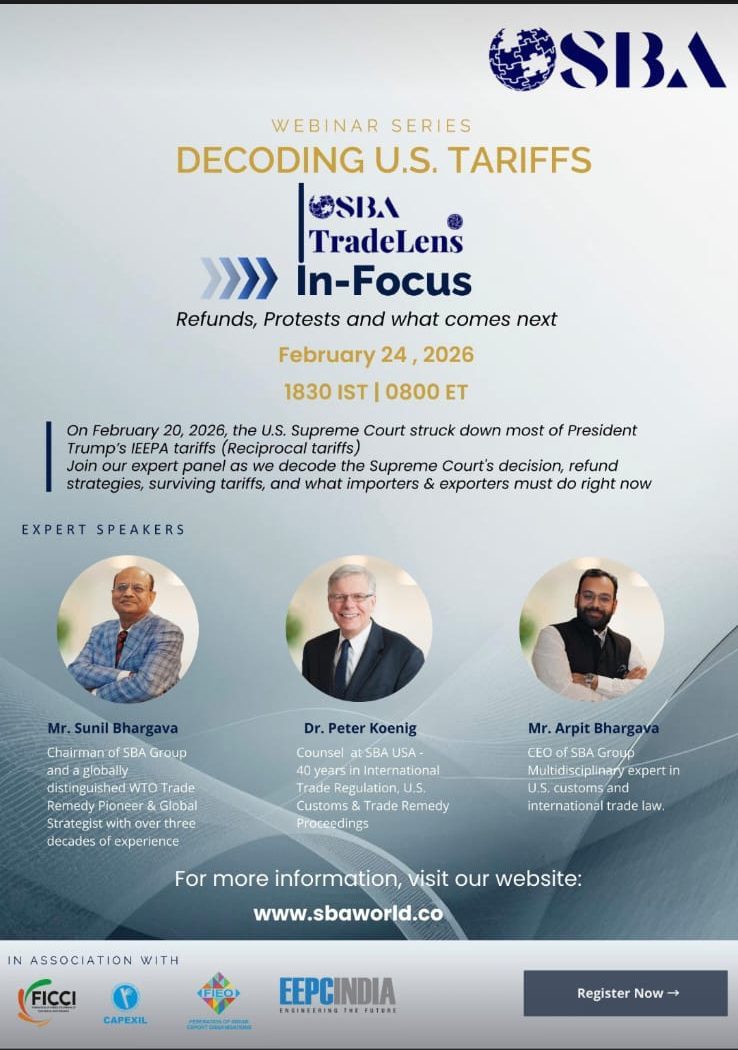
Join our panel of experts in the webinar series “Decoding US Tariffs” through February 24, 2026, to March 19, 2026, to get updates. Click here to register.
The professionals at SBA have deep experience advising clients on the range of issues associated with the IEEPA tariffs, the US Customs and Border Protection’s operational and administrative process for tracking and seeking refunds, and the disposition of those tariffs on appeal.
Our team includes Arpit Bhargava, Founding Partner and CEO, who is a Chartered Accountant and master’s in business law with rich experience in international trade laws and practice, and Dr. Peter Koenig, who brings almost 40 years of experience in international trade regulation, including antidumping and countervailing duty proceedings, U.S. Customs, and trade policy. For more information, please contact any of the authors or another professional at SBA that you regularly work with.
Trump Signs Executive Order Strengthening U.S. Customs Enforcement — Critical Implications for Foreign-Owned U.S. Companies
Authored by: Dr. Peter Koenig, David Craven, Arpit Bhargava and Arihant Jain | SBA Group | 4 June 2026
| AT A GLANCE | |
| Presidential Action | Executive Order — Strengthening Customs Enforcement (June 3, 2026) |
| Date Signed | June 3, 2026 |
| Legal Authority | 19 U.S.C. §§ 66, 1484, 1498, 1623, 1624, 4320; Constitution of the United States |
| Administering Agency | U.S. Customs and Border Protection (CBP), Department of Homeland Security |
| Key Focus | Importer of Record (IOR) eligibility; disclosure requirements; bond requirements; penalties; enforcement |
| Critical Definition | A U.S. IOR requires controlling beneficial owners to be U.S. citizens or LPRs. Entities with foreign controlling owners are classified as Foreign IORs regardless of U.S. incorporation. |
| Key Deadlines | 45 days (legislation recommendations) 90 days (new disclosure/certification rules, foreign export document requirement, penalties, disposal, transparency); 180 days (IOR rules and IOR eligibility revision, good standing rules, vetting, IOR registry Update); ; 1 Year ( full effectiveness report submitted to the President) |
| Highest Risk for | U.S. subsidiaries and affiliates of foreign-headquartered companies importing goods into the United States |
| Primary SBA Advisory | Immediate review of IOR status, ownership structure, bond levels, and compliance posture recommended |
EXECUTIVE SUMMARY
On June 3, 2026, President Trump signed an Executive Order on Strengthening Customs Enforcement, directing comprehensive reforms to the U.S. customs regime. [Sourced: EO, Section 1] The Order introduces heightened requirements for Importers of Record (IORs), with a particular focus on distinguishing between U.S. IORs and Foreign IORs. Its implications are most acute for U.S. companies where controlling beneficial ownership is held by foreign persons or entities [Sourced: EO, Section 10(a), 10(b)] — because under the Order’s definition, such companies are classified as Foreign IORs, even if they are incorporated in the United States, employ U.S. staff, and operate entirely from U.S. soil. This alert explains what has changed, what it means for your operations, and what steps should be taken now.
Q1: WHAT DOES THE EXECUTIVE ORDER DO?
Q: What is the overall purpose of this Executive Order?
A: The Order directs the Department of Homeland Security and CBP to overhaul the U.S. customs enforcement framework across five areas: (1) Importer of Record eligibility and registration; (2) import disclosure and certification requirements; (3) enforcement and penalties; (4) streamlined seizure and disposal of non-compliant imports; and (5) transparency. It also directs the submission of legislative recommendations within 45 days. The Order takes effect through a series of agency actions to be completed within 90 to 180 days.
The Executive Order directs the U.S. Department of Homeland Security and CBP to take targeted action across three interconnected areas of customs enforcement. First, it strengthens importer accountability by introducing a rigorous vetting and verification framework for Importers of Record, distinguishing between U.S. and Foreign IORs and establishing ongoing good standing requirements. Second, it directs enhanced enforcement against customs fraud — specifically undervaluation of goods, misclassification of products, and illegal transshipment — which the Order identifies as practices that undermine the integrity of U.S. trade law and erode the revenue base of the federal government. Third, it raises the financial security bar for higher-risk importers by mandating increased customs bond requirements and minimum domestic asset thresholds, ensuring that those who import into the United States bear a meaningful financial stake in their compliance obligations. [Sourced: EO, Sections 2, 3, 4]
DEFINITIONS — U.S. IOR AND FOREIGN IOR (AS DEFINED IN THE EXECUTIVE ORDER)
The Executive Order establishes distinct definitions for U.S. IOR and Foreign IOR in Section 10. These definitions are reproduced below in full, as they are central to understanding the compliance obligations that follow. The classification of your entity as a U.S. IOR or a Foreign IOR determines which requirements apply.
| Term | Definition (as per Executive Order, Section 10) |
| U.S. IOR | An IOR that is: (i) an individual who is a U.S. citizen or lawful permanent resident (LPR); OR (ii) an entity that is organized under U.S. law, located in the United States, AND has controlling beneficial owners who are U.S. citizens or LPRs at all times; OR (iii) an entity that owns a significant amount of real property in the United States, as determined by the Secretary. [EO, Section 10(a)] Note: The EO does not define ‘real property’ or ‘significant amount’ — both thresholds are left to the Secretary of Homeland Security to determine through future guidance. |
| Foreign IOR | An IOR that does not meet the definition of U.S. IOR. In the case of an entity, this means: not organized under U.S. law; OR not located in the United States; OR does not have controlling beneficial owners who are U.S. citizens or LPRs at all times; OR does not own a significant amount of U.S. real property. A U.S.-incorporated subsidiary of a foreign parent with controlling beneficial ownership held by non-U.S. persons is a Foreign IOR, unless it has significant US real property. [EO, Section 10(a) and 10(b)] |
| ‘Located in the United States’ (Entity) | To be ‘located in the United States’, an entity must have: (i) its principal place of business in the United States; (ii) a physical presence where significant business activity is conducted; AND (iii) sufficient tangible assets in the United States. CBP will issue guidance to prevent use of shell companies, sham transactions, or artificial corporate structures to qualify as a U.S. IOR. [EO, Section 10(c)] |
Q: My company is a wholly-owned subsidiary of a foreign company. Will we be considered a U.S. IOR or a Foreign IOR?
A: Under the Executive Order, your company will in all likelihood be classified as a Foreign IOR. A U.S. IOR requires, among other conditions, that its controlling beneficial owners be U.S. citizens or lawful permanent residents at all times. Where a U.S. entity is wholly owned by a foreign parent, the controlling beneficial ownership rests with the foreign parent (or its own owners). Unless those controlling beneficial owners independently qualify as U.S. citizens or LPRs, the U.S. subsidiary does not satisfy the beneficial ownership test and is classified as a Foreign IOR. [Sourced: EO, Section 10(a) and 10(b)]
Q2: WHO IS CLASSIFIED AS A FOREIGN IOR — AND WHY DOES IT MATTER?
Q: My company is a U.S. corporation with a U.S. address and U.S. employees. Are we a U.S. IOR or a Foreign IOR?
A: The answer to this question determines the full scope of your compliance obligations under the Order. The Order defines a U.S. IOR as an entity that is: (i) organized under U.S. law; (ii) located in the United States; AND (iii) has controlling beneficial owners who are U.S. citizens or lawful permanent residents (LPRs) at all times or owns a significant amount of real property in the United States. If your parent company — whether headquartered in India, Europe, Asia, or elsewhere — holds controlling ownership, your U.S. subsidiary does NOT qualify as a U.S. IOR, unless it has significant US real property. The term “significant US real property” is yet to be defined by the CBP and the Commerce Secretary. Thus, ab-initio a foreign owned business in USA is classified as a Foreign IOR and faces the additional requirements set out in Section 2 of the Order. [Sourced: EO, Section 2(b), 2(c)]
It is important to note that U.S. incorporation alone, a U.S. registered address, U.S. employees, and U.S. business operations may be insufficient to qualify as a U.S. IOR alone. [Sourced: EO, Section 10(a), 10(c)]. The Order also expressly directs CBP to issue guidance preventing entities from using shell companies, sham transactions, or artificial corporate structuring to qualify as a U.S. IOR — meaning that restructuring ownership on paper solely to meet the U.S. IOR threshold will not be effective. A wholly-owned foreign subsidiary should plan its customs compliance on the basis of Foreign IOR classification until CBP issues further guidance. [Sourced: EO, Section 10(c)]
Q3: WHAT SPECIFIC NEW REQUIREMENTS APPLY TO FOREIGN IORs?
Q: What additional requirements will Foreign IORs face that U.S. IORs will not?
A: The Order directs CBP to impose a series of heightened requirements on Foreign IORs specifically. These include:
- Prohibition on informal entry: Foreign IORs will be prohibited from filing informal entry (generally applicable to low-value shipments). All imports by Foreign IORs must be processed as formal entries under 19 U.S.C. §1484. [Sourced: EO, Section 2(b)]
- No continuous bonds for formal entry: Foreign IORs may not rely on a continuous bond to meet bond requirements unless CBP specifically determines that revenue is fully protected and compliance is assured. [Sourced: EO, Section 2(c)]
- CTPAT validation or CTPAT-validated broker required: Foreign IORs must be validated under CBP’s Customs-Trade Partnership Against Terrorism (CTPAT) program, if eligible, or must use a CTPAT-validated and licensed customs broker to file entries. [Sourced: EO, Section 2(c)]
- Minimum tangible domestic assets or bonding: All IORs (including Foreign IORs) must maintain a minimum level of tangible domestic assets, bonding, or both, as determined by CBP. Bond minimums will be increased. [Sourced: EO, Section 2(a)]
- Enhanced disclosure obligations: All IORs must provide CBP with anticipated import volumes, year of organization, ownership and beneficial ownership disclosures, business affiliation disclosures, and domestic asset disclosures. [Sourced: EO, Section 2(a)(iii)]
- Good standing requirement: All IORs must maintain good standing with CBP, assessed based on compliance history, payment of customs liabilities, and enforcement actions against the IOR and its affiliates. The |good standing” requirement will be enforced 180 days after June 1, 2026. IORs not in good standing will be barred from importing into the United States. [Sourced: EO, Section 2(d)]
IMPACT SUMMARY — FOREIGN-OWNED U.S. COMPANIES
| Requirement | Impact on Foreign-Owned U.S. Entities |
| Informal entry prohibition | Cannot use informal entry for any shipment; all imports must be filed as formal entries under 19 U.S.C. §1484. |
| Continuous bond restriction | May not rely on a continuous bond for formal entry unless CBP determines revenue is fully protected and compliance assured. [Sourced: EO, Section 2(c)(i)] |
| CTPAT validation | Must obtain CTPAT certification or appoint a CTPAT-validated customs broker — a process requiring time, investment, and compliance infrastructure. |
| Beneficial ownership disclosure | Must provide CBP with ownership and beneficial ownership disclosures, business affiliation disclosures, and domestic asset disclosures. [Sourced: EO, Section 2(a)(iii)] |
| Domestic asset / bond minimum | Must demonstrate sufficient U.S.-based tangible assets or post higher bonds — a significant cash or collateral burden for asset-light importers. |
| Good standing monitoring | Good standing will be assessed based on the IOR’s and its affiliates’ history of compliance with U.S. customs and trade laws and payment of customs liabilities, among other relevant considerations. [Sourced: EO, Section 2(d)] |
| Supply chain disclosure | Must certify compliance with CAATSA and other sanctions laws; must disclose foreign tax identifiers and detailed supply chain and manufacturing information. |
Q4: WHAT ARE THE ENFORCEMENT AND PENALTY CHANGES?
Q: How will penalties and enforcement change under this Order?
A: The Order directs CBP to take enhanced enforcement action. [Sourced: EO, Section 4] Key changes include: a minimum penalty floor of 50% of the assessed penalty, with no mitigation available for repeat offenders; enforcement of liquidated damages claims against bonds; maximum penalties for customs brokers who fail due diligence or repeatedly represent non-compliant clients; increased audits; and restrictions on the use of in-bond movements. The Order also directs prioritization of enforcement against forced labor violations, misclassification, undervaluation, and illegal transshipment. [Sourced: EO, Sections 4(a), 4(b), 4(c)]
Q5: WHAT ADDITIONAL DISCLOSURE REQUIREMENTS APPLY TO ALL IMPORTERS?
Q: Are there new supply chain disclosure requirements beyond IOR classification?
A: Yes. Within 90 days, CBP will establish heightened import disclosure and certification requirements for all importers. These include: certifying compliance with the Countering America’s Adversaries Through Sanctions Act (CAATSA) and other applicable laws; disclosing foreign tax identification numbers and global business identifiers; and providing detailed information about the imported good’s supply chain — including manufacturer product identifiers, composition, grade, and production methods. Importers will also be required to submit documentation that the foreign exporter was required to submit to its own customs authority prior to export. [Sourced: EO, Sections 3(a), 3(b)]
STRATEGIC OUTLOOK
The following actions are recommended by SBA Group based on the requirements set out in the Executive Order. These recommendations represent SBA advisory and should be verified against CBP guidance as it is issued.
- Determine your IOR classification immediately: Assess whether your U.S. entity qualifies as a U.S. IOR or a Foreign IOR under the beneficial ownership test. If your foreign parent holds controlling interest, assume Foreign IOR classification and plan accordingly.
- Enhanced Origin Verification Documentation: Section 3 of the Executive Order directs CBP to require additional importer data, supply-chain information, ownership disclosures, and product-level details to support customs enforcement and origin verification. As a result, manufacturers, importers and custom service providers will need stronger traceability systems and documentation controls to substantiate country-of-origin claims and production processes.
- Review your bonding and asset position: CBP will raise bond minimums and require Foreign IORs to demonstrate tangible U.S. assets or post transaction-specific bonds. A review of your current bond levels and U.S. asset base should begin immediately.
- Initiate CTPAT application if not already certified: The EO requires Foreign IORs to be CTPAT-validated, if eligible, or to use a CTPAT-validated licensed customs broker. [Sourced: EO, Section 2(c)(i)]
- Prepare beneficial ownership disclosures: Map and document the full beneficial ownership chain of your U.S. importing entity, including intermediate holding companies and the ultimate foreign parent. This information will be required to be submitted to CBP.
- Audit your customs compliance history: The good standing requirement will assess your IOR’s compliance history and that of its affiliates. Any open enforcement actions, unpaid duties, or past violations should be identified and addressed proactively.
- Review supply chain documentation: Prepare for heightened supply chain disclosure requirements, including CAATSA certifications and manufacturer-level product and production data. Engage your suppliers and freight forwarders to ensure documentation is available at the time of entry.
- Engage legal and trade counsel: Given the complexity and pace of the regulatory changes, companies should engage experienced U.S. customs and trade counsel to monitor CBP rulemaking and ensure timely compliance.
BUSINESS IMPACT NOTE
This Executive Order introduces comprehensive changes to U.S. customs enforcement with material compliance obligations for importers. For U.S. subsidiaries and affiliates of foreign-headquartered groups, it creates a new and materially more demanding compliance environment — with higher financial exposure, greater disclosure obligations, and heightened risk of import privilege suspension for non-compliance. The Order mandates agency action within 90 and 180 days respectively. [Sourced: EO, Sections 2, 3, 4, 5, 6] Companies that import through a U.S. entity with foreign controlling ownership should review their compliance position in light of these timelines.
| Manufacturers | Traders & Exporters | Service Providers |
| EO Section | EO Section | EO Section |
| Section 3 — Import disclosure & certification | Sections 2 & 3 — IOR verification, enhanced disclosures | Sections 2 & 6 — Vetting, accountability, transparency |
| Key Obligation | Key Obligation | Key Obligation |
| Provide detailed production, sourcing, and origin documentation to support US importer compliance | Maintain records proving valuation, classification, origin, and IOR identity across all sourcing tiers | Collect additional importer/manufacturer data; verify documentation; assist clients in audit and enforcement preparation |
| Primary Risk | Primary Risk | Primary Risk |
| Loss of US market access if production traceability cannot be demonstrated; exposure to transshipment allegations | Duty evasion allegations; rejection by US importers who cannot meet new IOR disclosure requirements | Increased liability for brokers who fail due diligence; maximum penalties for repeated non-compliant filings |
| What Needs to Change | What Needs to Change | What Needs to Change |
| Build traceability systems; maintain mill certificates, raw material sourcing records, and process documentation | Review all sourcing structures; prepare substantial transformation evidence; disclose beneficial ownership chain | Upgrade client onboarding to capture beneficial ownership, foreign tax IDs, and product-level data before entry filing |
| Example: An Indian steel manufacturer exporting through a US distributor may need to provide mill certificates, raw material sourcing records, and production logs to confirm genuine manufacture in India and rebut any transshipment allegation. | Example: A trader sourcing goods from China and exporting through Vietnam to US customers must provide evidence of substantial transformation and legitimate origin to avoid transshipment or duty-evasion findings. | Example: A customs broker handling entries for a US importer must now obtain beneficial ownership disclosures, foreign tax identification numbers, and enhanced product-level data before filing — or face penalty exposure for inadequate due diligence. |
SBA Group will issue further client alerts as implementing regulations are published.
This alert is prepared by SBA Group for informational and client advisory purposes only and does not constitute legal advice. It is based on the text of the Executive Order dated June 3, 2026. Clients should seek independent legal counsel for matters specific to their circumstances.
For Questions, Contact Our Team
Of Counsel SBA TradeLaw Inc., USA | Of Counsel SBA TradeLaw Inc., USA | Founding Partner & CEO SBA Group | Founding Partner & COO SBA Group |
Applications Filed by LDGE Fair Trade Coalition Seeking the Imposition of Antidumping and Countervailing Duties on Large Diameter Graphite Electrodes from India and China
1. Background and Overview
On February 24, 2026, applications seeking the imposition of antidumping and countervailing duties on imports of large diameter graphite electrodes from China and India were filed before the U.S. Department of Commerce and the U.S. International Trade Commission. The applications were submitted by the LDGE Fair Trade Coalition, which represents the entirety of U.S. domestic production. The U.S. authorities are currently required to examine the applications to determine whether the statutory requirements for initiation are satisfied.
2. Period of Investigation
- Dumping and Subsidy Period of Investigation Department of Commerce 1st January, 2025 to 31st December, 2025.
- Injury Period U S International Trade Commission 1st January, 2023 to 31st December, 2025.
3. Petitioners and Domestic Industry Support
The petitions were filed by Tokai Carbon GE LLC and Resonac Graphite America Inc and are supported by GrafTech International Ltd a former U S producer. Petitioners account for 100 percent of U S large diameter graphite electrode production thereby satisfying the statutory standing requirements under U S trade law.
4. Indian Exporters & Producers
Identified in the Petition (add Chinese exporters)
- Graphite and Carbon Industries India Private Limited, Mumbai, Maharashtra, India.
- Graphite India Ltd., Kolkata, West Bengal, India.
- HEG Ltd., Noida, Uttar Pradesh, India.
5. Product Scope
Covered Merchandise
The investigations cover
- Large diameter graphite electrodes finished or unfinished
- Electrodes exceeding 425 millimeters 16 point 7 inches in nominal or actual diameter
- Electrodes with or without graphite pin joining systems
- Electrodes imported assembled or separately
For purposes of the investigation the country of origin is determined by the country of graphitization which is a critical factor for scope and circumvention analysis.
Indicative HTSUS classifications include 8545.11.0020, 3801.10.5090, and 3801.90.0050, though the written scope description is dispositive.
6. Trade Volumes
| Source/ Year | 2022 | 2023 | 2024 | Jan-Nov 2024 | Jan-Nov 2025 |
| India | 3,543 | 2,082 | 2,294 | 2,162 | 792 |
| China | 3,957 | 4,950 | 5,947 | 4,629 | 3,564 |
| Total Imports | 45,961 | 30,980 | 25,920 | 22,163 | 20,497 |
*all data is in metric tons
7. Key Allegations
I. Antidumping Allegations
Alleged dumping margins are as follows;
China
Alleged dumping margins exceeding 36.82 percent to over 146.41 percent including very high transaction specific margins due to constructed normal value methodologies.
India
Alleged dumping margins range approximately from 42.92 percent to over 74.02 percent depending on the producer exporter and product configuration and if accepted even in part may result in very high provisional cash deposit requirements at the preliminary determination stage.
II. Countervailing Duty Allegations
The petitions allege that producers in China and India benefit from actionable government subsidies including:
- Preferential financing and state backed lending
- Provision of inputs including raw materials and energy at less than adequate remuneration
Tax incentives and regional development programs - Export linked and performance-based incentive schemes
- Purchase of Coal at less than adequate remuneration (LTAR)
The petitions emphasize the capital intensive and energy intensive nature of graphite electrode production which magnifies the impact of subsidization.
8. Injury Allegations
The U S International Trade Commission is examining whether imports from China and India have increased significantly in absolute and relative volume have undercut suppressed and depressed U S prices and have reduced capacity utilization profitability and market share of the domestic industry while also creating a threat of material injury due to excess capacity and export orientation of foreign producers. Petitioners further assert that large diameter graphite electrodes constitute a single domestic like product distinct from small diameter graphite electrodes due to differences in technical characteristics and end use applications.
9. Commercial Impact on Exporters and Importers
If affirmative determinations are made preliminary antidumping and countervailing duties may be imposed within months of initiation with potential retroactive duty exposure in the event of a critical circumstances finding. Exporters will be required to respond to extensive Department of Commerce questionnaires covering sales cost and subsidy information and any failure to cooperate may result in the application of adverse facts available with combined antidumping and countervailing duty rates becoming commercially prohibitive.
10. Times and action points
Submission of ITC Preliminary Questionnaires – March 10, 2026
ITC Preliminary hearing – March 17, 2026
ITC Preliminary Vote – April 9, 2026 (Determines if case will go forward)
SBA’s team of trade experts is closely tracking developments at the U.S. ITC and the U.S. Department of Commerce and stands ready to support businesses as they navigate this evolving and complex trade landscape.
U.S. Initiates Antidumping and Countervailing Duty Investigations on Citric Acid Imports from India and Canada
Product: Citric Acid and Certain Citrate Salts
Countries Concerned: India and Canada
Investigating Authorities: U.S. Department of Commerce (DOC) and U.S. International Trade Commission (USITC)
Period of Investigation: January 1, 2025 – December 31, 2025
Background and Overview
The U.S. Department of Commerce and the U.S. International Trade Commission have formally initiated parallel antidumping (AD) and countervailing duty (CVD) investigations on imports of citric acid and certain citrate salts from India and Canada under Sections 731 and 701 of the Tariff Act of 1930.
These investigations follow petitions filed by major U.S. producers alleging unfair pricing and subsidization by foreign exporters. If affirmative determinations are made, additional duties may be imposed on imports from both countries, with significant implications for market access and pricing.
Case Details
Investigation Type | India Case No. | Canada Case No. |
Antidumping (AD) | A-533-946 | A-122-877 |
Countervailing Duty (CVD) | C-533-947 | C-122-878 |
Product Scope
The investigations cover anhydrous and hydrous citric acid, sodium and potassium citrate, calcium citrate intermediates, and blends containing 40 percent or more citric acid or citrate content. Indicative HTSUS classifications include 2918.14, 2918.15, and 3824.99, though classification alone does not determine scope coverage.
Key Allegations
Antidumping Allegations
Petitioners allege that Indian exporters sold subject merchandise in the U.S. at less than fair value, with alleged dumping margins ranging from 58.99 percent to 252.37 percent, based on constructed cost-based normal values and U.S. customs data, indicating a high likelihood of substantial provisional duties.
Countervailing Duty Allegations
The petition alleges that Indian exporters benefit from actionable subsidies, including export incentives (Duty Drawback, Advance Authorization, EPCG, MEIS), preferential financing (EXIM Bank support and interest equalization), and tax and renewable energy incentives, which may result in countervailing duties if substantiated.
The petition also alleges transnational subsidization, claiming that Indian exporters benefit indirectly from subsidized inputs sourced from China.
Injury Allegations
The USITC is examining whether imports from India and Canada have caused or threaten material injury through increased volumes, price undercutting and suppression, loss of market share, and declining sales and profitability, with an affirmative finding required for duties to be imposed.
Major Indian Exporter Identified
Daffodil Pharmachem Pvt. Ltd. has been identified as the largest Indian exporter, accounting for approximately 60 percent of subject imports. Please find attached the list of all the exporters at the end.
Commercial Impact on Exporters
Affected exporters may face significant provisional and final duties, possible retroactive liability, heightened scrutiny of costs and sourcing, increased compliance burdens, and adverse facts available for non-cooperation, with cumulative AD and CVD rates potentially affecting pricing and contract viability.
Conclusion
The initiation of AD and CVD investigations on citric acid from India and Canada presents substantial duty exposure, with alleged dumping margins exceeding 250 percent and novel transnational subsidy claims.
Exporters should treat this case as strategically significant and adopt proactive compliance and litigation strategies to mitigate adverse outcomes.
List of Indian Exporters During the Period of Investigation
S.No. | Name of the Exporters | Sum of Metric Tons |
1. | A R Chemical | 401.00 |
2. | Acaris Health LLP | 736.53 |
3. | Amogha Oil Tools Private Limited | 22.04 |
4. | Buradon Inc | 14.69 |
5. | Chemical Crunch Private Limited | 226.41 |
6. | Cocreate Global Tech Private Limited | 143.86 |
7. | Daffodil Pharmachem Private Limted | 9,507.52 |
8. | Dorf Ketal Chemicals India Limited` | 32.93 |
9. | Euroasia Trans Continental | 4.23 |
10. | Geocon Products | 1,601.30 |
11. | Hartman Enterprises LLP | 20.80 |
12. | Hexagon Supplies LLP | 40.78 |
13. | India Phosphate & Allied | 40.50 |
14. | Indiana Chem Port | 14.39 |
15. | Kamataz Sourcing & Consulting Private Limited | 9.61 |
16. | Kronox Lab Sciences Limited | 165.68 |
17. | Mass Dye Chem Private Limited | 35.90 |
18. | Medilane Healthcare Private Limited | 40.08 |
19. | Meru Chem Private Limited | 45.01 |
20. | Mireca International | 496.34 |
21. | Nature Bio | 984.56 |
22. | Not Declared | 1,184.30 |
23. | NRS Chemical LLP | 206.86 |
24. | PHS Life Sciences Private Limited | 19.80 |
25. | Prachin Chemical | 106.25 |
26. | Pure Trueherb Private Limited | 20.52 |
27. | Shanpar Industries Private Limited | 49.84 |
28. | Smile Seller International | 248.18 |
29. | Stenfy Chem | 463.68 |
30. | Sunil Chemicals | 10.04 |
31. | Synthocure Pharma LLP | 4.14 |
32. | V Care Medicines | 16.09 |
33. | Valaji Pharma Chem | 0.02 |
34. | Vcare Medicines | 16.09 |
35. | Wang Pharmaceuticals & Chemicals | 180.62 |
36. | Xitrical Group Co. Limited | 38.14 |
The top 5 Indian Exporters are :
Name of the Exporter | Total Percent |
Daffodil Pharmachem Private Limted | 59.6% |
Geocon Products | 10.0% |
Nature Bio | 6.2% |
Acaris Health LLP | 4.6% |
Mireca International | 3.1% |
For Any Queries Kindly Connect With Us on: Arpit Bhargava / Radhika Sharma / Dr. Peter Koenig
Trump Further Adjusts Section 232 Tariff Regimes for Aluminum, Steel, and Copper — Client Q&A
Authored by: Dr. Peter Koenig, Arpit Bhargava and Arihant Jain
SBA Group | 2 June 2026
AT A GLANCE | |
Presidential Action | Proclamation — Further Adjusting Tariff Regimes for Aluminum, Steel & Copper (June 1, 2026) |
Date Signed | June 1, 2026 |
Effective Date | June 8, 2026 (12:01 a.m. EDT) — for goods entered or withdrawn from warehouse |
Legal Authority | Section 232, Trade Expansion Act of 1962 (19 U.S.C. 1862); Section 604, Trade Act of 1974 |
Prior Proclamation Amended | Proclamation 11021 of April 2, 2026 (and Proclamations 9704, 9705, 10962) |
Metals Covered | Aluminum, Steel, and Copper — articles and derivative products |
Key Questions Addressed | Changes to duties on metal articles & derivatives │ Effective dates │ Products remaining at 50% │ Planning strategies |
Expiry of Temp. Modifications | December 31, 2027 (clause 2 rates); clause 3 of Proclamation 11021 rates resume January 1, 2028 |
U.S. Metal Threshold | Reduced from 95% to 85% by weight to qualify for lower domestic-content duty rate |
Executive Summary
On June 1, 2026, President Donald J. Trump signed a Proclamation further adjusting the tariff regimes for imports of aluminum, steel, and copper into the United States, effective June 8, 2026. Acting under Section 232 of the Trade Expansion Act of 1962, the Proclamation amends prior tariff actions — most recently Proclamation 11021 of April 2, 2026 — to account for the productive economic roles of key downstream industries, including American agriculture, construction, and industrial logistics, while continuing to address national security threats. This Q&A alert addresses the five most critical questions for importers and manufacturers affected by this Proclamation.
Q1: What are the Changes to Duties on Steel, Aluminum & Copper Articles?
Q: Has the 50% duty on core steel, aluminum, and copper articles changed?
A: No. The 50% ad valorem Section 232 duty on core steel, aluminum, and copper articles (Annex I-A) remains unchanged and continues to apply to the full value of goods from all countries not qualifying for the country-specific or USMCA-adjusted rates below.
Q: Are there country-specific rates for these metal articles?
A: Yes. For imports from Argentina, Ecuador, El Salvador, Guatemala, Japan, South Korea, Liechtenstein, Switzerland, Taiwan, the United Kingdom, and EU member nations, the Section 232 duty is calibrated to the product’s Column 1 HTSUS rate:
- Column 1 rate below 15%: The combined duty (Column 1 + Section 232) is capped at 15%.
- Column 1 rate 15% or above: No additional Section 232 duty applies (zero additional duty).
Q: What about imports from Canada and Mexico (USMCA)?
A: For USMCA-qualifying goods from Canada and Mexico, a 25% duty applies only to the non-U.S. content of the product. The total effective duty cannot be less than 15% ad valorem. CBP will issue guidance on content calculation. Importers who misrepresent U.S. content face penalties.
Q: Is there a reduced rate for products made with U.S. domestic metal?
A: Yes. A 10% rate applies to derivative articles whose aluminum was entirely smelted and cast, or steel entirely melted and poured, in the United States. The threshold for qualifying as ‘entirely’ domestic has been reduced from 95% to 85% by weight — opening a wider path to lower duties for manufacturers committed to American metal sourcing.
Category | Applicable Duty Rate |
All countries (general) | 50% on full value — core articles (Annex I-A) |
Favoured countries (EU, Japan, Korea, UK, etc.) | Column 1 rate; sum capped at 15%; zero add’l if Col.1 ≥15% |
Canada / Mexico (USMCA-qualifying) | 25% on non-U.S. content only; minimum 15% effective rate |
U.S.-smelted/melted metal content ≥85% of total | 10% (reduced domestic-content rate) |
Q2: What are the Changes to Duties on Derivatives of Steel, Aluminum & Copper?
Q: What was the previous derivative duty structure under Proclamation 11021?
A: Under Proclamation 11021 (April 2, 2026), derivative articles were subject to either 25% (standard derivatives, Annex I-B) or a temporarily-reduced 15% (fixed industrial machinery and power equipment, Annex III).
Q: What has changed for derivative articles under this new Proclamation?
A: Three material changes have been made:
- Agricultural equipment & residential HVAC moved to 15% (NEW): These product categories are transferred from the 25% derivative tier to the temporarily-reduced 15% tier (Annex III), effective June 8, 2026 through December 31, 2027.
- New temporary category for mobile industrial equipment (Annex I-C): Forklifts, bulldozers, cranes, excavators, graders, road rollers, and similar self-propelled machinery are placed in a new temporary clause-2 rate structure. Rates depend on country of origin (25% general; lower for favoured countries and USMCA). This treatment runs until December 31, 2027.
- New derivatives added: Aluminum lithographic plates and steel racks are newly brought within Section 232 scope as derivative products, subject to the applicable derivative tariff, to prevent circumvention.
Q: What is the duty on standard derivative articles not in a special category?
A: Standard derivatives listed in Annex I-B remain subject to a 25% ad valorem duty on the full value of goods, with the same country-specific adjustments as described in Q1.
Category | Applicable Duty Rate |
Standard derivative articles (Annex I-B) | 25% ad valorem |
Fixed industrial machinery & power equipment (Annex III) | 15% — temporary through Dec 31, 2027 |
Agricultural equipment (Annex III — NEW) | 15% — temporary through Dec 31, 2027 |
Residential HVAC systems & components (Annex III — NEW) | 15% — temporary through Dec 31, 2027 |
Mobile industrial equipment (Annex I-C — NEW) | Country-specific rate (10–25%); temporary through Dec 31, 2027 |
Aluminum lithographic plates & steel racks (NEW) | Applicable derivative tariff (25%) |
Q3: What is the Effective Date of the Changed Duties?
Q: When do the new rates take effect?
A: The new rates apply to goods entered for consumption, or withdrawn from warehouse for consumption, on or after 12:01 a.m. Eastern Daylight Time (EDT) on June 8, 2026. The Proclamation does not provide for any grace period, phase-in, or explicit in-transit exemption.
Q: Are these changes permanent?
A: Not entirely. The modified rates for mobile industrial equipment (Annex I-C) and the expanded 15% category for agricultural equipment and residential HVAC (Annex III) are temporary — they apply until 11:59 p.m. EST on December 31, 2027. From January 1, 2028, rates revert to those set out in clause (3) of Proclamation 11021. The 50% rate on core metal articles (Annex I-A) and the 25% rate on standard derivatives (Annex I-B) are not time-limited under this Proclamation.
Q4: Are There Products on Which the Duty Remains at 50%?
Q: Which products continue to carry a 50% Section 232 duty?
A: Yes. All core aluminum, steel, and copper articles listed in Annex I-A remain subject to a 50% ad valorem duty on full value, for imports from countries not qualifying for the favoured-country or USMCA treatment. These include:
- Steel: Base steel mill products — flat-rolled products (HTS 7208–7212), tubes and pipes (7304–7306), wire (7213–7217, 7229), structural sections (7216), stainless steel (7218–7223), alloy steel (7224–7228), railway materials (7302), and containers (7309–7311).
- Aluminum: Core aluminum articles as specified in prior Proclamation 9704 annexes.
- Copper: Core copper articles as specified under Proclamation 10962.
Note: Even for these 50% products, the effective rate may be lower for favoured-country imports or where 85%+ U.S. domestic metal content is used (10% rate).
Q5: How Can We Plan Around This Uncertainty?
Q: Given the temporary nature of several rate changes, how should importers and manufacturers plan?
A: This is where SBA Group’s trade advisory capability is most valuable. The combination of time-limited relief, country-specific rate structures, and evolving HTSUS classifications creates both risk and opportunity. The following planning strategies are recommended:
Strategic Outlook
Businesses and importers should act on the following priorities:
- Front-load procurement before December 31, 2027: If your products qualify for the 15% rate (agricultural equipment, HVAC, fixed industrial machinery) or the reduced mobile equipment rates, accelerate procurement and shipments where commercially viable to lock in lower duties before the reversion to higher clause-3 rates on January 1, 2028.
- Review U.S. domestic metal content eligibility: The Proclamation reduces the threshold for a product’s metal content to qualify as ‘entirely’ U.S.-smelted or melted from 95% to 85% by weight, enabling access to the 10% Section 232 duty rate. Importers and manufacturers should review their purchases of derivative products to identify whether articles made predominantly with U.S.-origin aluminum or steel can be sourced from suppliers who qualify for this exemption. For exporters, this opens a strategic opportunity: by incorporating U.S.-content aluminum or steel at or above the 85% threshold into derivative products, exporters can ship to the United States at the 10% rate rather than the standard 25% or 50% — significantly improving the competitiveness of their U.S.-bound exports.
- Country of origin and Column 1 rate review: If your goods originate from a favoured country (EU, Japan, Korea, UK, etc.), verify the applicable Column 1 HTSUS duty rate to confirm the correct effective Section 232 rate. For products with Column 1 rates of 15% or above, no additional Section 232 duty applies — this is a material benefit that should be captured in your entry strategy.
- USMCA content certification: For Canadian and Mexican suppliers, ensure that U.S. content calculations and certifications are accurate and maintained. CBP will impose penalties for fraud or deliberate misrepresentation of U.S. content. A structured content-tracking process is advisable to support compliance.
- Supply chain and contractual restructuring to optimise dutiable value: Where commercially and legally viable, importers should review their supply chain structures and contractual arrangements with a view to optimising the value on which Section 232 duties are assessed. This may include revisiting incoterms, intercompany pricing, and transaction value allocation across the supply chain. Any such restructuring must be undertaken in full compliance with U.S. customs law — including the transaction value rules under 19 U.S.C. §1401a — and must conform to transfer pricing principles established by the OECD Transfer Pricing Guidelines for Multinational Enterprises and Tax Administrations. Artificial or non-arm’s-length arrangements will not withstand CBP scrutiny and may attract penalties.
- Product classification audit: The addition of aluminum lithographic plates, steel racks, agricultural equipment, and residential HVAC to new tariff categories will affect duty treatment for affected importers. A targeted HTSUS classification review of affected products is strongly recommended.
Business Impact Note
This Proclamation represents a significant and carefully targeted expansion of the Section 232 tariff framework, with material implications for importers and manufacturers across the agricultural equipment, HVAC, industrial logistics, and aluminum lithographic plate industries — sectors specifically referenced in the Proclamation. The inclusion of mobile industrial equipment under a temporarily modified duty structure provides near-term relief, while the reduction of the domestic metal content threshold to 85% opens a wider pathway to lower duties for manufacturers committed to American metal sourcing.SBA Group advises all clients with exposure to aluminum, steel, or copper derivative products to review their HTSUS classifications, entry strategies, and supplier sourcing in light of these changes. Our trade advisory team is available to assist with product classification reviews, duty exposure analysis, and compliance planning.
This alert is prepared by SBA Group for informational and client advisory purposes only and does not constitute legal advice. Clients should seek independent legal counsel for matters specific to their circumstances.
For Questions, Contact Our Team
Of Counsel SBA TradeLaw Inc., USA | Founding Partner & CEO SBA Group | Founding Partner & COO SBA Group |
SBA TRADELAW INC. | CLIENT Q&A GUIDE
Section 232 Tariff Overhaul: What You Need to Know
Steel, Aluminum & Copper | Presidential Proclamation of April 2, 2026
Authored by: Dr. Peter Koenig · Arpit Bhargava · Radhika Sharma · Piyush Tainwala
SBA Group | April 3, 2026
On April 2, 2026, the White House issued a Presidential Proclamation that fundamentally restructures the Section 232 tariff regime covering steel, aluminum, and copper. The changes affect duty rates, how duties are calculated, and which products are covered. This guide answers the questions we are hearing most from clients — in plain language.
Note: This analysis is preliminary and subject to revision as we review agency guidance and consult with stakeholders.
⚠ CRITICAL DEADLINE: New rules apply to all goods entered for consumption or withdrawn from warehouse on or after 12:01 a.m. EST, Monday, April 6, 2026.
Section I — The Basics
Q: What exactly changed on April 2, 2026?
A: President Trump signed a Proclamation that rewrites three key elements of the existing Section 232 tariff framework: (1) how duties are calculated — now on the full customs value of the product, not just its metal content; (2) the duty rates themselves, which now vary by product tier; and (3) which products are covered, with some items added and others removed.
Q: Who does this affect?
A: If your business imports — or relies on suppliers who import — any of the following, you are affected: steel, aluminum, or copper in raw or semi-finished form; finished goods made substantially from these metals; industrial or electrical equipment with significant metal components. Exporters shipping to the U.S. market are equally impacted.
Q: When do the new rules take effect?
A: April 6, 2026 at 12:01 a.m. EST. Any goods already in transit and entered before that date-time are generally subject to the old rules, but you should verify this with your customs broker for your specific entries.
Q: What is Section 232, and why does it matter?
A: Section 232 of the Trade Expansion Act of 1962 allows the President to impose tariffs on imports that threaten U.S. national security. Unlike ordinary tariffs, Section 232 duties can be imposed quickly and without Congressional approval. They sit on top of any existing duties — meaning your total landed duty cost is the sum of normal customs duties plus the Section 232 rate.
Section II — The New Duty Rates
Q: What are the new duty rates at a glance?
The new structure uses three tiers based on how metal-intensive your product is:
| Annex | Products | Base Rate | US-Origin Rate |
| I-A | Core Metals & Primary Derivatives | 50% | 10% |
| I-B | Secondary Derivatives | 25% | 10% |
| III | Industrial & Grid Equipment | 15% floor* | 15% floor* |
* Annex III floor rate applies until December 31, 2027, after which these products move to Annex I-B (25%).
The table below summarizes the broad product categories covered across each Annex, based on the White House publication dated April 2, 2026. For full HTS-code level detail, consult the source Annexes directly.
| Annex | Products | Base Rate | US-Origin Rate |
| I-A (50%) | Raw Steel | 50% | Ingots, billets, slabs, blooms — nonalloy, stainless & alloy steel |
| I-A (50%) | Flat-Rolled Steel | 50% | Hot- & cold-rolled coils/sheets/strip (wide & narrow); clad, plated or coated products (HTS 7208–7212) |
| I-A (50%) | Steel Bars, Rods & Sections | 50% | Hot-rolled bars & rods in coils; angles, beams, channels, H/I/U sections (HTS 7213–7216) |
| I-A (50%) | Steel Wire | 50% | Nonalloy, stainless and alloy steel wire (HTS 7217, 7223, 7229) |
| I-A (50%) | Steel Tubes & Pipes | 50% | Seamless & welded pipes, hollow profiles, OCTG (HTS 7304–7306) |
| I-A (50%) | Steel Structural Products | 50% | Sheet piling, railway track construction material (HTS 7301, 7302) |
| I-A (50%) | Steel Derivatives — Fittings & Fasteners | 50% | Pipe fittings, flanges, threaded fittings, screws, bolts, nuts, rivets, washers (HTS 7307, 7318) |
| I-A (50%) | Steel Derivatives — Structures & Containers | 50% | Bridges, towers, doors/windows, scaffolding, tanks, drums, compressed gas containers (HTS 7308–7311) |
| I-A (50%) | Steel Derivatives — Wire Products | 50% | Stranded wire, ropes, cables, barbed wire, fencing, grill & netting (HTS 7312–7314) |
| I-A (50%) | Steel Derivatives — Chains, Springs & Misc. | 50% | Chains, anchors, nails, tacks, springs, pins, needles, grinding balls (HTS 7315–7320, 7325–7326) |
| I-A (50%) | Raw Aluminum | 50% | Unwrought aluminum, bars, rods, profiles, wire, sheets, foil (HTS 7601, 7604–7607) |
| I-A (50%) | Aluminum Tubes, Pipes & Fittings | 50% | Seamless & welded tubes, pipe fittings and couplings (HTS 7608–7609) |
| I-A (50%) | Aluminum Castings & Forgings | 50% | Cast and forged aluminum articles (HTS 7616) |
| I-A (50%) | Aluminum Derivatives — Structures & Containers | 50% | Aluminum doors/windows, structural sections, collapsible tubes, drums, gas containers (HTS 7610–7613) |
| I-A (50%) | Aluminum Derivatives — Cable & Wire | 50% | Stranded wire, electrical conductors, cables with steel core (HTS 7614) |
| I-A (50%) | Copper — Primary Forms | 50% | Copper/brass/bronze bars, rods, profiles, wire in all alloy forms (HTS 7406–7408) |
| I-A (50%) | Copper — Flat Products | 50% | Plates, sheets, strip and foil — refined copper and all copper alloys (HTS 7409–7410) |
| I-A (50%) | Copper — Tubes, Pipes & Fittings | 50% | Seamless & other tubes/pipes; fittings for all copper alloys (HTS 7411–7412) |
| I-A (50%) | Copper — Wire, Fasteners & Articles | 50% | Stranded wire, cables, nails, washers, screws, rivets, springs, sanitary ware, table/kitchen articles (HTS 7413–7419) |
| I-B (25%) | Domestic Appliances & Cookware | 25% | Gas/liquid fuel stoves, ranges, grates, space heaters, washers, dryers, dishwashers, refrigerators, freezers, A/C units |
| I-B (25%) | Household Articles & Cutlery | 25% | Sinks, baths, sanitary ware, table & kitchen articles, cookware, cutlery, flatware (spoons, forks, ladles) |
| I-B (25%) | Hardware & Building Fittings | 25% | Hinges, door closers, mountings, fittings for buildings and furniture, staples, flexible tubing, stoppers & caps |
| I-B (25%) | Industrial Machinery & Equipment | 25% | Pumps, compressors, valves, heat exchangers, turbines, generators, transformers, electric motors, bearings, gears |
| I-B (25%) | Construction & Earthmoving Equipment | 25% | Bulldozers, graders, scrapers, excavators, loaders, cranes, hoists, forklift trucks |
| I-B (25%) | Agricultural Machinery | 25% | Tractors, plows, mowers, combine harvesters, threshers and parts thereof |
| I-B (25%) | Railway Equipment | 25% | Locomotives, passenger coaches, tank cars, freight wagons, track maintenance vehicles, couplers, truck assemblies |
| I-B (25%) | Road Vehicles & Parts | 25% | Tractors for semi-trailers, motor vehicles, trailers, semi-trailers, bumpers, gear boxes, mufflers, clutches |
| I-B (25%) | Electrical Equipment | 25% | Transformers, AC motors, wind turbine generators, electrical conductors, conduit tubing, antennae |
| I-B (25%) | Wind Energy Components | 25% | Wind turbine towers, gear boxes, blades, hubs, AC generators and parts (covered across steel & aluminum derivatives) |
| I-B (25%) | Containers & Prefabricated Structures | 25% | Intermodal shipping containers, prefabricated steel buildings |
| I-B (25%) | Aluminum Cookware & Household Articles | 25% | Cast & non-cast aluminum bakeware, cooking ware, kitchen articles, sanitary ware, luggage frames, ladders, venetian blinds |
| I-B (25%) | Copper Electrical Conductors | 25% | Insulated copper conductors for telecom and general use (≤1,000 V), fitted with connectors |
| II (Exempt) | Food & Dairy Products | 0% | Concentrated milk and cream (sweetened); food preparations not canned or frozen |
| II (Exempt) | Chemicals & Refrigerants | 0% | HFCs, HFOs, propylene, oxygen, helium; steam cylinder oils; antifreeze; solvents and thinners |
| II (Exempt) | Paints, Coatings & Adhesives | 0% | Paints and varnishes (all polymer types, aqueous and non-aqueous); mastics and putties; adhesive preparations |
| II (Exempt) | Personal Care & Cosmetics | 0% | Perfumes, shampoos, deodorants, cosmetics, skin care, hair preparations, oral hygiene products |
| II (Exempt) | Cleaning & Polishing Products | 0% | Detergents, surface-active preparations, lubricants, polishes, scouring compounds |
| II (Exempt) | Pesticides & Disinfectants | 0% | Insecticides, herbicides, disinfectants, fungicides — all packaging sizes |
| II (Exempt) | Cast Iron Cookware | 0% | Cast iron bakeware and kitchen articles (enameled and non-enameled) |
| II (Exempt) | Motorcycles & Parts | 0% | Motorcycles (>250cc, >800cc, electric); parts and accessories for motorcycles |
| II (Exempt) | Medical / Military Vehicles | 0% | Mobile radiological units, mobile medical clinics, armored fighting vehicles (tanks) |
| II (Exempt) | Furniture & Seating | 0% | Metal-framed seats (upholstered and not), office and other metal furniture, furniture parts |
| II (Exempt) | Sporting & Leisure Goods | 0% | Physical exercise, gymnastics and athletics equipment and parts |
| II (Exempt) | Plastics Doors & Containers | 0% | Plastic doors, windows, frames; plastic buckets and pails |
| II (Exempt) | Certain Engine Parts | 0% | Outboard marine engines, tractor/vehicle compression-ignition engines, aircraft motor/generator parts |
| II (Exempt) | Electronics & Office Equipment | 0% | Parts of computers/ADP machines, certain printed circuit assemblies, photographic plates |
Q: What falls under Annex I-A — and why does the 50% rate matter so much?
A: Annex I-A covers raw and primary metal products: steel billets, slabs, and ingots; aluminum ingots, bars, and plates; copper rods and bars; and any finished article made entirely or almost entirely from these metals. At 50% on the full import value, most supply chains sourcing these materials from outside the U.S. will find costs unworkable. This tier is designed to push buyers toward domestic U.S. metal sources.
Q: What falls under Annex I-B at 25%?
A: Annex I-B covers derivative goods — products where metal is a major component but not the only value driver (think certain industrial components, consumer durables, or fabricated metal parts). The shift to full customs value is most disruptive here: previously, duties may have applied only to the metal content value; now, the 25% rate applies to the entire invoice price, including labor, overhead, and non-metal components.
Q: What is the Annex III ‘floor’ and which products does it cover?
A: Annex III was created for industrial and electrical grid equipment — products critical to infrastructure that the government does not want to make prohibitively expensive. The mechanism works as a top-up: if your product’s normal (Column 1) duty rate is below 15%, Section 232 tops it up to a minimum of 15%. If the normal duty is already 15% or higher, no Section 232 charge applies. This protection expires on December 31, 2027 — after which these products automatically move to the 25% Annex I-B rate.
Q: Is there a special rate for UK-origin goods?
A: Yes. For Annex I-B products (25% standard rate), goods of UK origin receive a 10% discount, bringing their effective Section 232 rate to 15%. This reflects the bilateral trade arrangement with the UK. No equivalent preference currently applies to EU, Japan, Korea, or other trade agreement partners under this Proclamation.
Section III — The Full Customs Value Shift
Q: What changed about how duties are calculated?
A: This is the most consequential change for many importers. Previously, Section 232 duties on finished goods were often assessed only on the value of the metal content — not the whole product. Under the new rules, duties apply to the full customs value of the imported article — the entire price you paid, including fabrication, finishing, non-metal components, and any other value added. There is no longer a ‘steel content exemption.’
Q: Can you give me a simple example of how this changes my duty bill?
A: Imagine you import a fabricated steel component priced at $100. Its steel content value is $40.
- Under the old rule (metal content only): 25% × $40 = $10 Section 232 duty.
- Under the new rule (full customs value): 25% × $100 = $25 Section 232 duty.
That is a 150% increase in your duty liability on the same product at the same price. Multiply this across a full import portfolio and the financial exposure is substantial.
Section IV — Reducing Your Duty Rate to 10%
Q: Is there a way to get a lower rate than 50% or 25%?
A: Yes — but the bar is high. For Annex I-A and I-B products, a 10% rate is available if 100% of the metal content in your product was melted and poured (steel) or smelted and cast (aluminum/copper) in the United States. You must obtain a government-recognised certificate to this effect. Partial U.S. metal content does not qualify — it is all-or-nothing.
Q: What is a ‘Melted and Poured’ or ‘Smelted and Cast’ certificate?
A: It is a certification — typically from the U.S. metal producer — confirming that the raw metal used in your product was produced in the United States at the primary production stage. For steel, this means the melt shop. For aluminum and copper, this means the primary smelter or casting facility. Your supplier must be able to provide this documentation, and it must cover all of the metal in the finished product.
Q: What should I do if I cannot get a 100% U.S.-origin certificate?
A: You will pay the standard tiered rate (50% or 25% on full customs value). You should evaluate whether: (a) you can restructure your supply chain to source metal from U.S. producers; (b) your product qualifies for a de minimis exemption; or (c) your product may fall under Annex III’s lower floor rate. Each situation requires individual analysis — contact our team for a portfolio review.
Section V — Exemptions, Special Rules & Edge Cases
Q: Are there any products that are exempt from Section 232 entirely?
A: Yes. Annex II of the Proclamation excludes certain categories from Section 232 scope altogether. These include specified chemicals, food products, consumer goods, and motorcycles. If your product falls in one of these categories, it is removed from Section 232 coverage — but you should verify the specific HTS codes against the Annex to confirm.
Q: What is the de minimis exemption and do I qualify?
A: For Annex I-B and Annex III products only, a de minimis exemption applies if: (1) your product is not classified in HTS Chapters 72, 73, 74, or 76 (the core metal chapters), and (2) the weight of the metal in your product is less than 15% of the total article weight. Both conditions must be satisfied simultaneously. This exemption does not apply to Annex I-A products.
Q: My product contains both steel and aluminum — does it get hit twice?
A: No. The Proclamation contains a single-assessment rule: if your product appears on multiple Annex lists (e.g., both steel and aluminum lists), the Section 232 duty is assessed only once, at the applicable rate for the primary classification. You will not be double-charged.
Q: What happens if my supplier uses any Russian aluminum?
A: You face a 200% duty — regardless of which Annex your product falls under. The existing Proclamation 10522 prohibitive rate on Russian aluminum remains fully in force. This applies to any article produced in Russia or containing any quantity of primary aluminum smelted or cast in Russia. Even trace amounts can trigger this rate if your supplier cannot certify Russian-origin-free metal. Due diligence on your aluminum supply chain is essential.
Q: What about Foreign Trade Zones (FTZs)?
A: New admissions to FTZs must now be made under ‘privileged foreign status.’ This is a significant change for FTZ operators, as it means the duty rate is determined at the time of admission — not at the time of entry for consumption. Goods admitted prior to the Proclamation will be subject to the new ad valorem rates when they exit the FTZ for U.S. consumption. If you operate through an FTZ, review your admissions strategy immediately.
Q: Can I claim duty drawback if I re-export products?
A: Manufacturing drawback is now strictly limited to Annex I-B and Annex III products, and only if the goods originate from a Trade Agreement Partner (UK, EU, Japan, Korea, Mexico, or Canada) using metal that was melted/poured or smelted/cast within those partner countries. Drawback on Annex I-A products and on goods from non-partner countries is no longer available. If drawback has been part of your import economics, you need to reassess your model.
Section VI — Administrative & Process Changes
Q: Can I apply to have my product excluded from Section 232?
A: The formal product inclusion/exclusion process that existed under prior regulations has been terminated. It is replaced by a rolling authority granted to the Secretary of Commerce and the U.S. Trade Representative (USTR). Practically speaking, this means there is no longer a defined public process through which individual companies could petition for product-specific exclusions in the traditional sense. Metal containers — even those filled with non-metal goods — are explicitly brought within scope under this new authority.
Q: How do I know exactly which HTS codes are in each Annex?
A: The White House has published the full Annex lists. You should cross-reference your product’s HTS classification against each Annex. Our team can assist with HTS classification reviews and Annex mapping for your specific product portfolio.
Section VII — What You Should Do Now
The April 6 deadline is immediate. Do not wait for further guidance before auditing your exposure.
We recommend the following immediate steps:
- Identify every HTS code in your import portfolio and map it against Annexes I-A, I-B, and III.
- Calculate your revised duty liability under the full customs value methodology.
- Determine whether any of your products qualify for the de minimis exemption or Annex II removal.
- Audit your metal supply chain for Russian aluminum exposure — at any tier of your supplier base.
- Request ‘Melted and Poured’ / ‘Smelted and Cast’ certificates from U.S. metal suppliers if you wish to qualify for the 10% preferential rate.
- Review your FTZ admissions strategy if you operate through or ship via a Foreign Trade Zone.
- Reassess duty drawback models if you rely on manufacturing drawback for re-exported goods.
- Renegotiate supply contracts where tariff pass-through clauses may now allocate unexpected liability.
For Questions, Contact Our Team
Of Counsel SBA TradeLaw Inc., USA | Founding Partner & CEO SBA Group | Founding Partner & COO SBA Group | Senior Manager – Audit & Cost SBA Group |
Adjusting Imports of Processed Critical Minerals and Their Derivative Products
By: Manu Agrawal & Arpit Bhargava
The Presidential Proclamation titled “Adjusting Imports of Processed Critical Minerals and Their Derivative Products into the United States” was issued by the President of the United States on January 14, 2026, pursuant to the national security authorities under Section 232 of the Trade Expansion Act of 1962 (19 U.S.C. § 1862).
Context & Legal Foundation
- The proclamation follows a Section 232 national security investigation conducted by the U.S. Department of Commerce into the importation of processed critical minerals and their derivative products (PCMDPs).
- Under Section 232, the President may adjust imports of articles entering the U.S. when such imports are determined to be threatening to national security.
- The proclamation concludes that imports of PCMDPs are currently being brought into the United States in such quantities and under such circumstances as to threaten to impair national security.
National Security Findings
- Processed critical minerals and derivative products are deemed essential to national defense, critical infrastructure, and industrial capabilities.
- The United States is highly dependent on foreign supplies of these processed minerals, even where domestic mining exists, because domestic processing capacity is insufficient.
- This reliance on imported processing exposes the U.S. to strategic vulnerabilities, supply disruptions, and foreign leverage, including from countries that dominate processing capacity globally.
Core Directive Negotiations Over Immediate Tariffs
Instead of imposing immediate tariffs or quotas, the proclamation directs a negotiated approach:
- Negotiation Mandate
- The Secretary of Commerce and the United States Trade Representative (USTR) are instructed to jointly pursue negotiations with trading partners to adjust PCMDP imports to mitigate identified national security risks.
- Negotiations should consider a range of potential trade terms, including price floors for critical minerals and derivative products, aimed at stabilizing markets and enhancing supply-chain resilience.
- These agreements may be structured as binding bilateral or multilateral instruments under Section 232(c)(3)(A)(i).
- B. Reporting Deadline
- Negotiators must report progress back to the President within 180 days of the proclamation’s date i.e., by mid-July 2026.
Future Trade Remedies and Conditional Measures
- The proclamation reserves the President’s authority to take additional actions if negotiations fail to achieve meaningful adjustments within the 180-day timeframe or are otherwise ineffective.
- Possible future measures include, but are not limited to:
- Minimum import price commitments for specific PCMDPs.
- Tariffs or other import adjustments designed to reduce dependence on foreign processing.
Strategic & Policy Implications
- Supply Chain Resilience
- By focusing on negotiations before tariffs, the U.S. is signaling a preference for cooperative supply-chain management with allies and trade partners, seeking to lock in diversified and secure sources of critical minerals.
- Emphasis on price floors reflects an intent to address market volatility and investment disincentives that have hampered domestic processing capacity, particularly for battery metals, rare earths, and other strategic materials.
- National Security Linkage
- Critical minerals are central to defense manufacturing, aerospace systems, energy infrastructure, telecommunications, and advanced technologies — making their reliable supply foundational for both economic and national security.
- The proclamation frames supply-chain diversification and reduced import reliance as an essential national security priority.
- Geopolitical and Commercial Effects
- Major processing hubs, particularly in Asia (e.g., China), may face increased pressure to conclude agreements that align with U.S. security and supply-chain diversification goals.
- U.S. companies with global supply dependencies may need to reassess sourcing strategies, contractual clauses, and exposure to future tariff risk if negotiations do not yield desired outcomes.
IMPACT ON TRADE
The Presidential Proclamation on processed critical minerals marks a structural shift in global trade governance. By placing critical mineral imports under Section 232 national security authority, the United States has moved this sector out of the rules-based trade system and into a security-driven regulatory framework.
Although no immediate tariffs are imposed, the permanent threat of future import restrictions introduces sustained uncertainty into global critical mineral markets. Exporters now face long-term risk that tariffs or minimum price controls may be imposed, weakening price stability, contract certainty, and investment planning.
The negotiated-access model further weakens multilateral trade norms. Market access is no longer governed primarily by WTO rules, but by strategic alignment with U.S. supply-chain priorities, accelerating the fragmentation of global trade into geopolitical blocs.
For companies, commercial competitiveness alone is no longer sufficient. Continued access to the U.S. market increasingly depends on supply-chain alignment with U.S. national security objectives, raising compliance costs and encouraging supply-chain restructuring.
Overall, the proclamation deepens the securitisation of international trade, replacing neutral market rules with conditional, power-based access in strategic sectors.
Source:
- https://www.federalregister.gov/documents/2026/01/20/2026-01045/adjusting-imports-of-processed-critical-minerals-and-their-derivative-products-into-the-united
- https://www.csis.org/analysis/new-executive-order-ties-us-critical-minerals-security-global-partnerships
For Any Queries Kindly Connect With Us on: Arpit Bhargava / Radhika Sharma / Dr. Peter Koenig
| Title | Category | Publish Date | Download Link |
|---|---|---|---|
| Navigating Force Majeure Events | Trade Alerts | Wednesday, 15 April 2026 | |
| IEEPA Refund Path And Section 301 Tariff Update | IEEPA Alerts | Friday, March 20, 2026 | |
| New US Trade Frameworks for Southeast Asia | Trade Alerts | Thursday, 26 February 2026 | |
| Sec 122 Tariff Alerts | IEEPA Alerts | Tuesday, 24 February 2026 | |
| Restoring U.S. Semiconductor Leadership Through Trade, Tariffs, and Strategic Alliances | SEC-232 | Friday, January 31 2026 | |
| US Exits Key International Organizations | Trade Alerts | January, 7 2026 | |
| Section 232 Tariffs on Timber | SEC-232 | Wednesday, December 31 2025 | |
| US Announces New Section 232 Tariffs | SEC-232 | Monday, September 29, 2025 | |
| Section 232 Tariffs on Copper | SEC-232 | Monday, August 4, 2025 | |
| Section 232 Tariffs on Copper | SEC-232 | Monday, August 4, 2025 | |
| US Imposes 25% Tariff on Indian Imports | Trade Alerts | Thursday, August 7, 2025 | |
| Reciprocal Tariff Modifications | Trade Alerts | Monday, August 4, 2025 | |
| India-UK FTA: Key Developments | Trade Alerts | Saturday, July 26, 2025 | |
| US-Philippines Trade Deal: Key Developments | Trade Alerts | Wednesday, July 23, 2025 | |
| US-Japan Trade Deal: Key Takeaways | Trade Alerts | Wednesday, July 23, 2025 | |
| Indonesia-US Trade Deal: A New Chapter | Trade Alerts | Saturday, July 19, 2025 | |
| South Korea-US BTA: Deadline Nears | Trade Alerts | Saturday, July 5, 2025 | |
| India-US BTA: Key Challenges Ahead | Trade Alerts | Friday, July 4, 2025 | |
| US-Vietnam Deal: Impact on India | Trade Alerts | Thursday, July 3, 2025 |